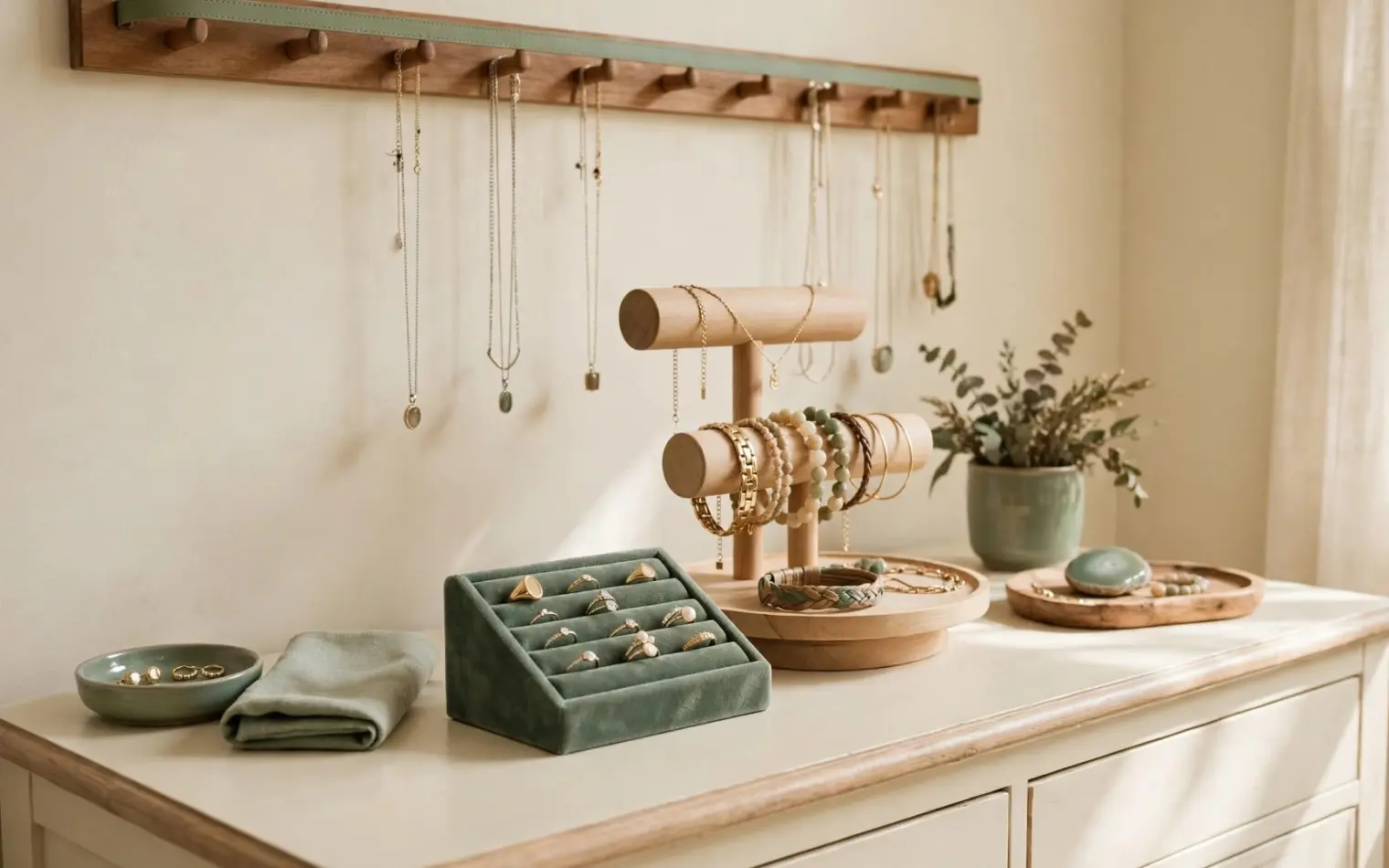
Store jewelry separated and visible: necklaces hanging individually so chains can’t tangle, earrings paired in a divided tray, rings on a stand or in slots — and silver in anti-tarnish pouches away from bathroom humidity.
Thank you for reading this post, don’t forget to subscribe!These jewelry storage ideas are grouped by storage spot — wall, dresser, drawer, door and travel — so you can start with the spot that bothers you most. The rule for every spot is the same: separated and visible, with silver kept away from humidity.
On the wall: hooks and rails that keep chains apart
The wall is the best spot for necklaces, because hanging is the only storage that keeps every chain apart. A rail, a pegboard or a frame turns a blank wall into the display your jewelry deserves.
1. Wall-mounted necklace hook rail for untangled chains
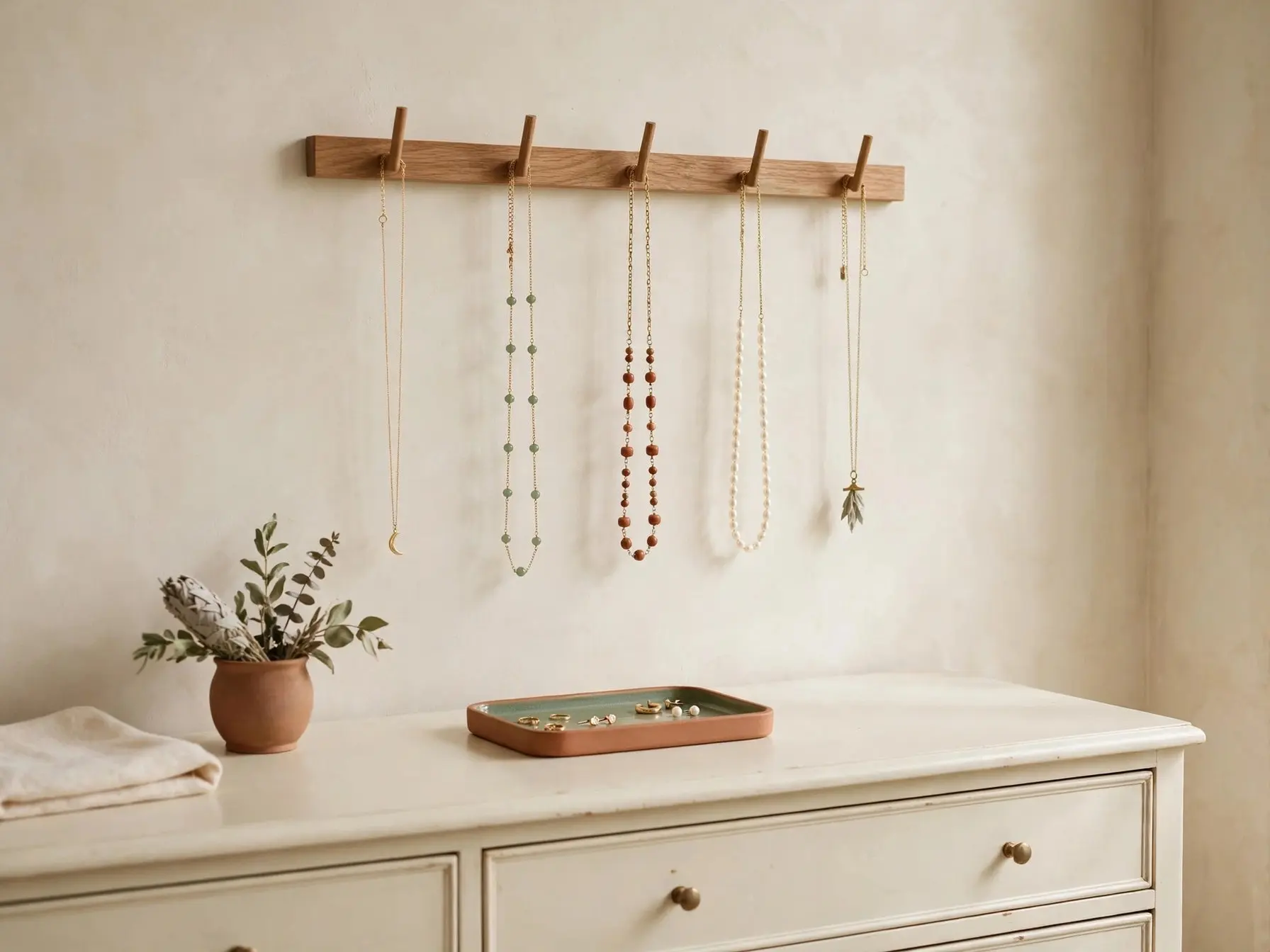
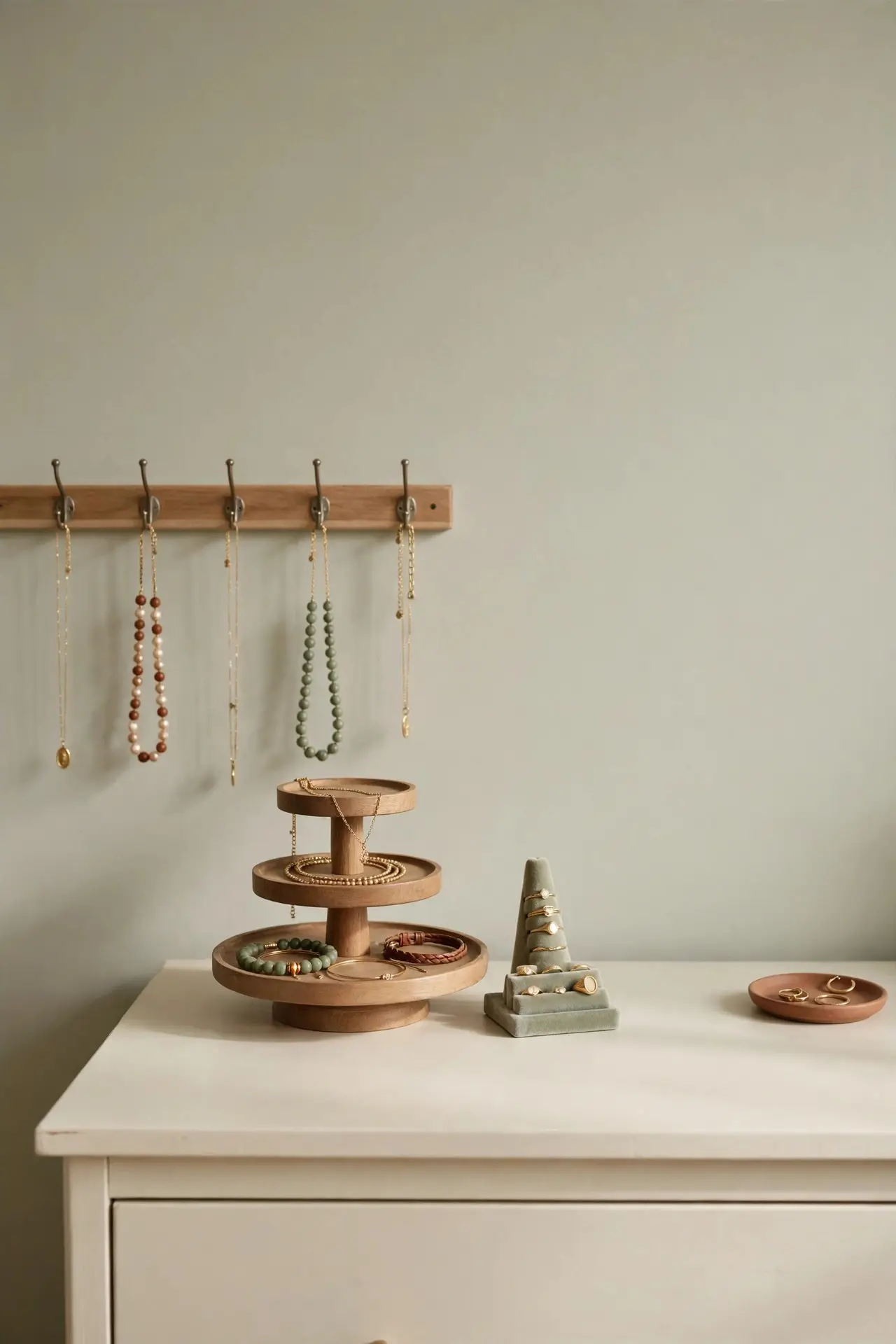
A hook rail is the simplest fix for tangled necklaces: one hook per chain, mounted on the wall above the dresser or inside a closet door. Each necklace hangs straight down with nothing to catch on, so chains that used to knot in a drawer stay separate. Choose a rail with hooks spaced at least two inches apart — close hooks let chains swing into each other — and keep the longest necklaces on the end hooks where they hang free. Mount it with two screws into a stud or wall anchors, and the whole collection becomes wall art you can see at a glance.
- One hook per chain, hooks at least two inches apart
- Longest necklaces on the end hooks
- Fix into a stud or use wall anchors
2. Pegboard jewelry wall above the dresser
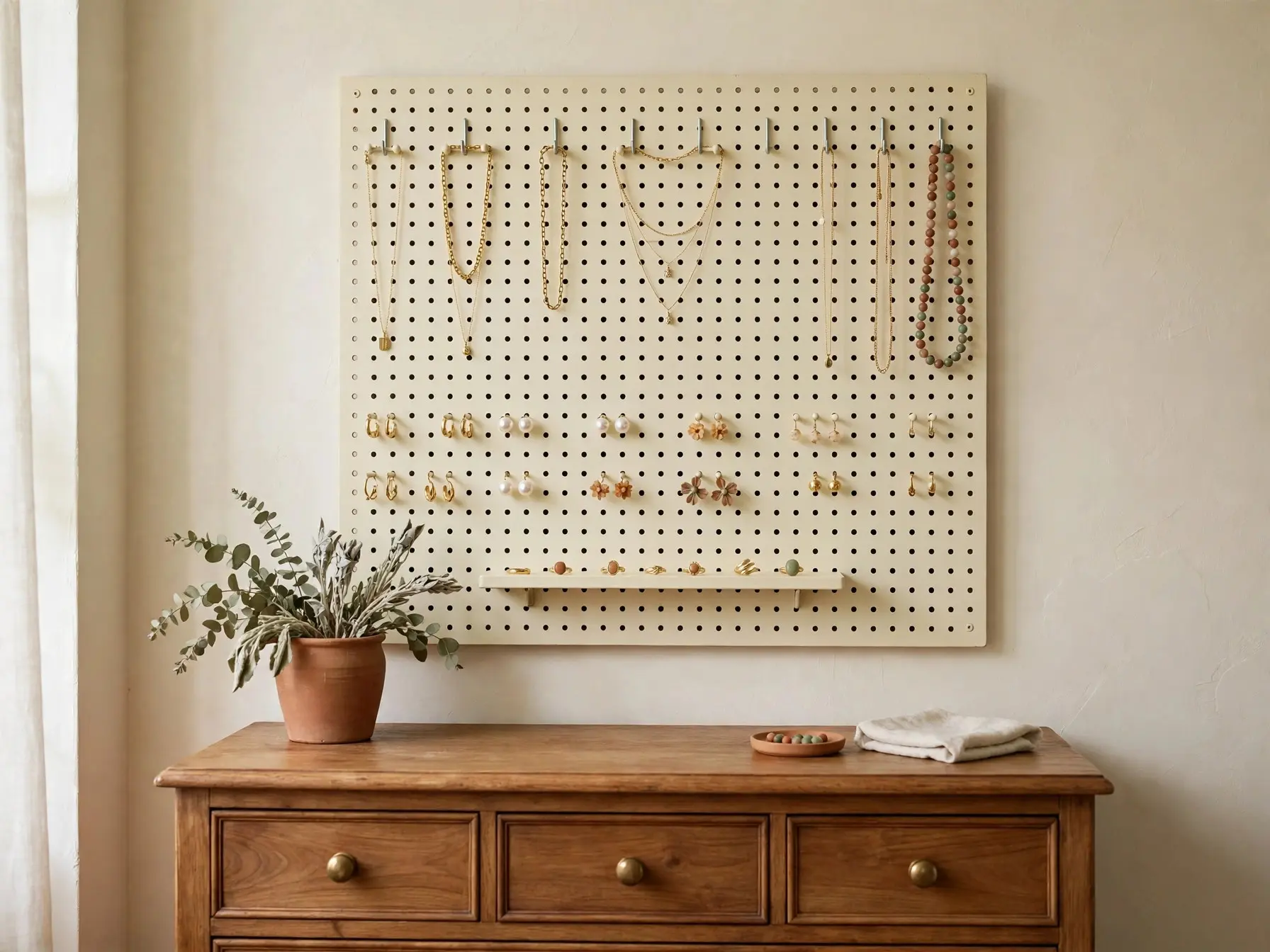
A pegboard turns a blank wall above the dresser into a jewelry display that grows with the collection. Small hooks hold necklaces and bracelets, short pegs hold earring pairs, and a tiny shelf at the bottom catches rings and the pieces you wear daily. Paint the board the same cream as the wall so the jewelry is the decoration, and leave a few empty pegs — a full board is a board with no room for the next piece. Everything stays visible, so the necklace at the back of a drawer finally gets worn.
- Hooks for necklaces, short pegs for earring pairs
- Paint the board cream so the jewelry stands out
- Leave a few empty pegs for new pieces
3. Framed earring display that doubles as wall art
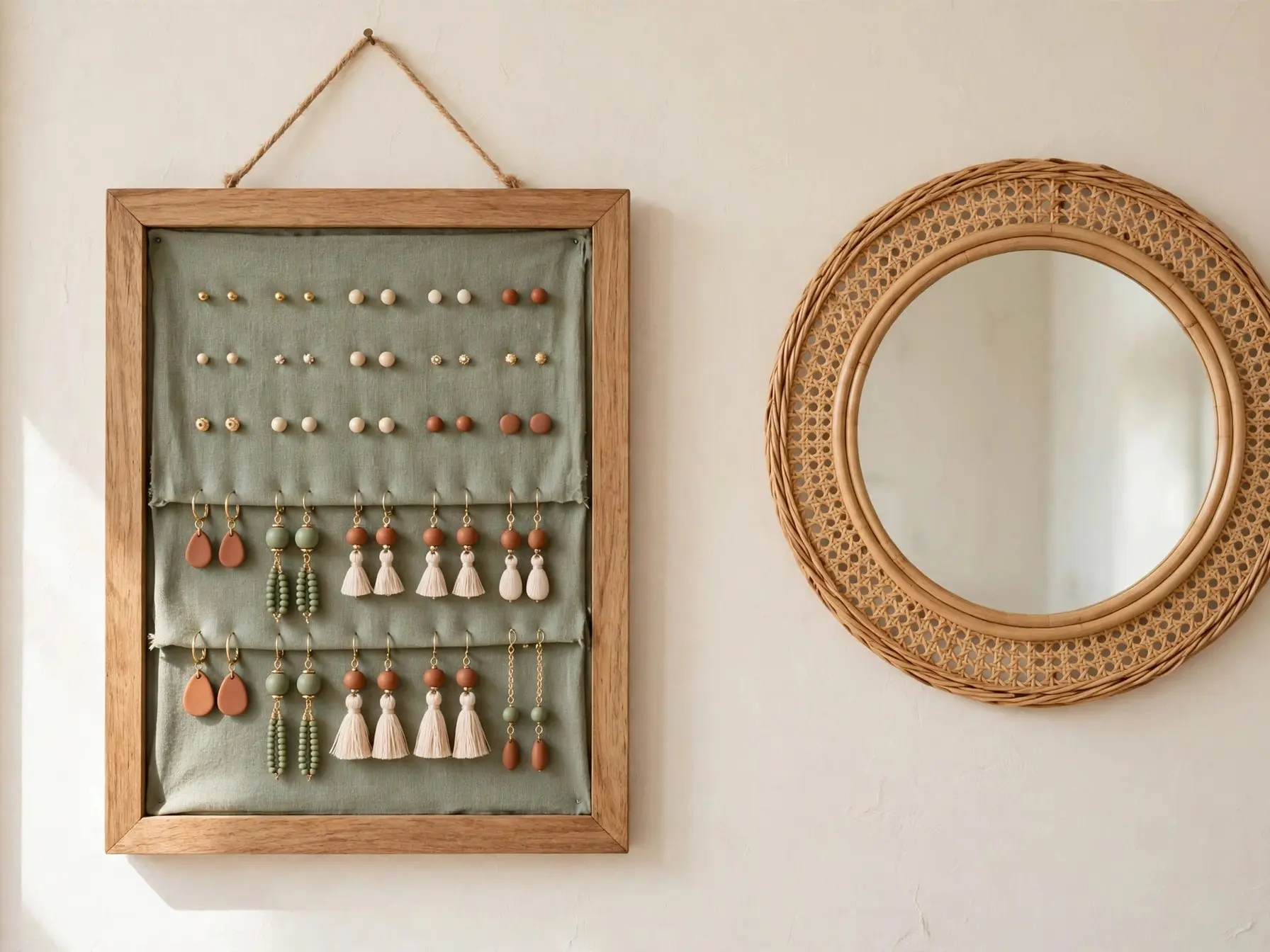
Earring pairs vanish in a drawer, but on a fabric-lined frame they are all visible at once. Stretch linen or mesh across an open frame, hang it on the wall beside the mirror, and hook each pair through the fabric — studs at the top, dangles below, sorted by color or by how often you wear them. A frame about twelve inches square holds a surprising number of pairs without looking crowded. It is the prettiest storage on this list, and it costs less than most organizers.
- Studs at the top, dangles below
- Sort by color or by how often you wear them
- A twelve-inch frame holds a full collection
On the dresser: stands that show everything at a glance
The dresser top holds the daily pieces — the ones you reach for every morning. A stand keeps them visible and apart, so the morning routine takes seconds instead of minutes of untangling.
4. Tiered jewelry tree stand for the daily pieces
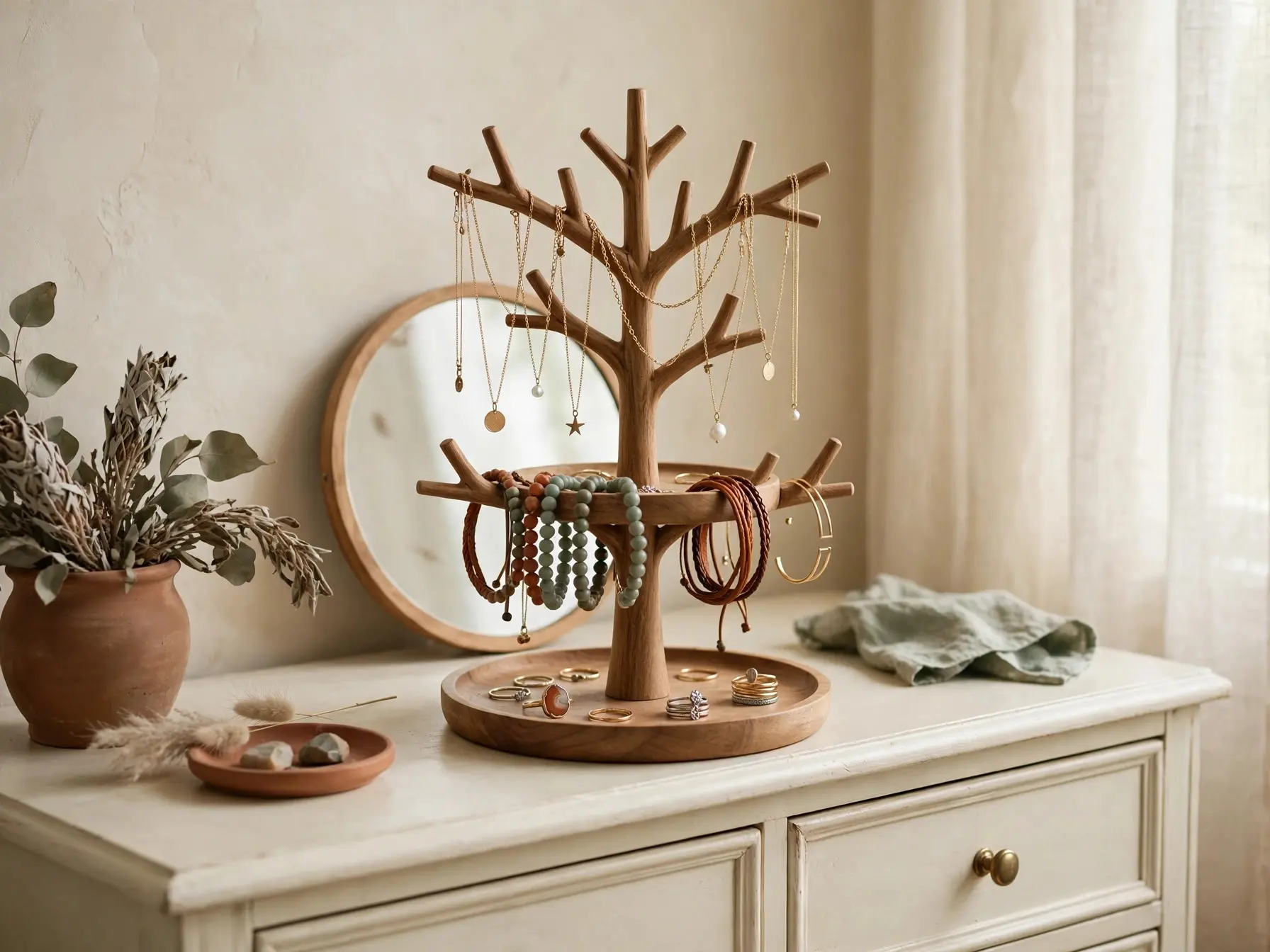
A tiered stand is the dresser-top home for the pieces you wear every day. Necklaces drape over the top arms, bracelets slide onto the middle tier, and the base dish holds rings and the watch — everything in one spot, visible the moment you open your eyes. Choose a stand with arms at different heights so chains of different lengths do not tangle, and keep it small: a stand about ten inches tall holds the daily set without swallowing the dresser. At night, the stand is the reminder to put each piece back where it belongs.
- Necklaces on the top arms, bracelets on the middle tier
- Arms at different heights so chains cannot tangle
- A ten-inch stand holds the daily set
5. Ring stand with individual slots for every ring
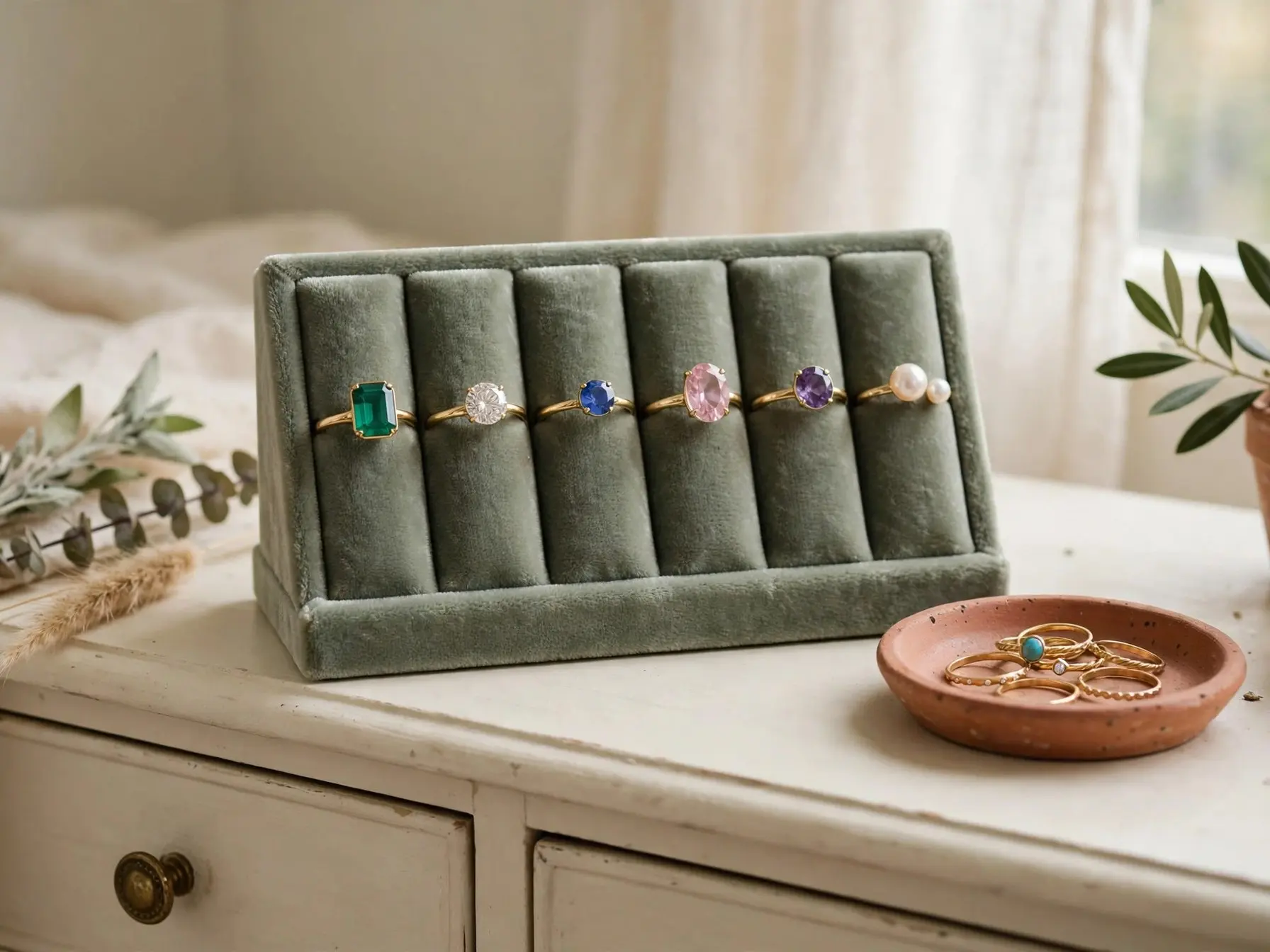
Rings are the easiest pieces to lose and the hardest to find in a pile, so give each one its own slot. A ring stand — a velvet-covered cone, a row of slots, or a small dish with dividers — holds every ring upright where you can see the stone and grab the one you want. Keep the daily rings on the stand on the dresser and the rest in a divided tray in the drawer, and never stack rings loose in a dish where they scratch each other. One stand per dresser is usually enough.
- One slot per ring, stones visible
- Daily rings on the stand, the rest in a tray
- Never stack rings loose where they scratch
6. T-bar bracelet stand that keeps bangles in order
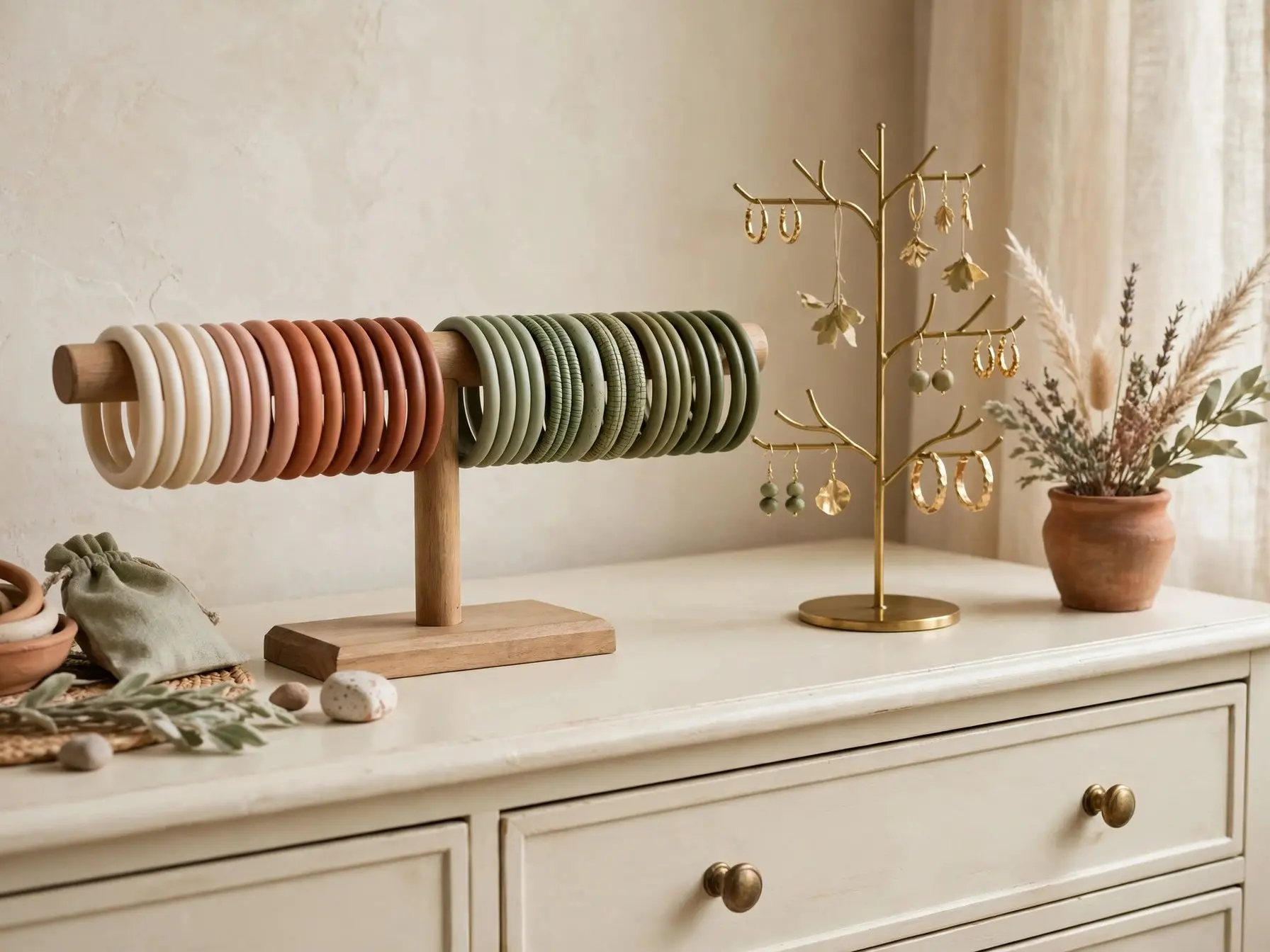
Bangles and bracelets roll, tangle and disappear in a drawer, but on a T-bar stand they stay in a neat row. Slide each bracelet onto the horizontal bar, sorted by color or by how often you wear them, and the whole set is visible at a glance — no digging, no knots, no missing match. A bar about eight inches wide holds a dozen bangles, and a second bar on the back doubles the space. Keep the stand on the dresser next to the jewelry tree, and the morning routine takes seconds.
- Slide bracelets on in color order
- An eight-inch bar holds about a dozen bangles
- A second bar on the back doubles the space
In the drawer: trays that give every piece a slot
The drawer is where the rest of the collection lives, divided and visible so nothing rolls or hides. Trays, slots and a ring roll keep a shallow drawer working like a jewelry box.
7. Divided velvet tray for earrings in a shallow drawer
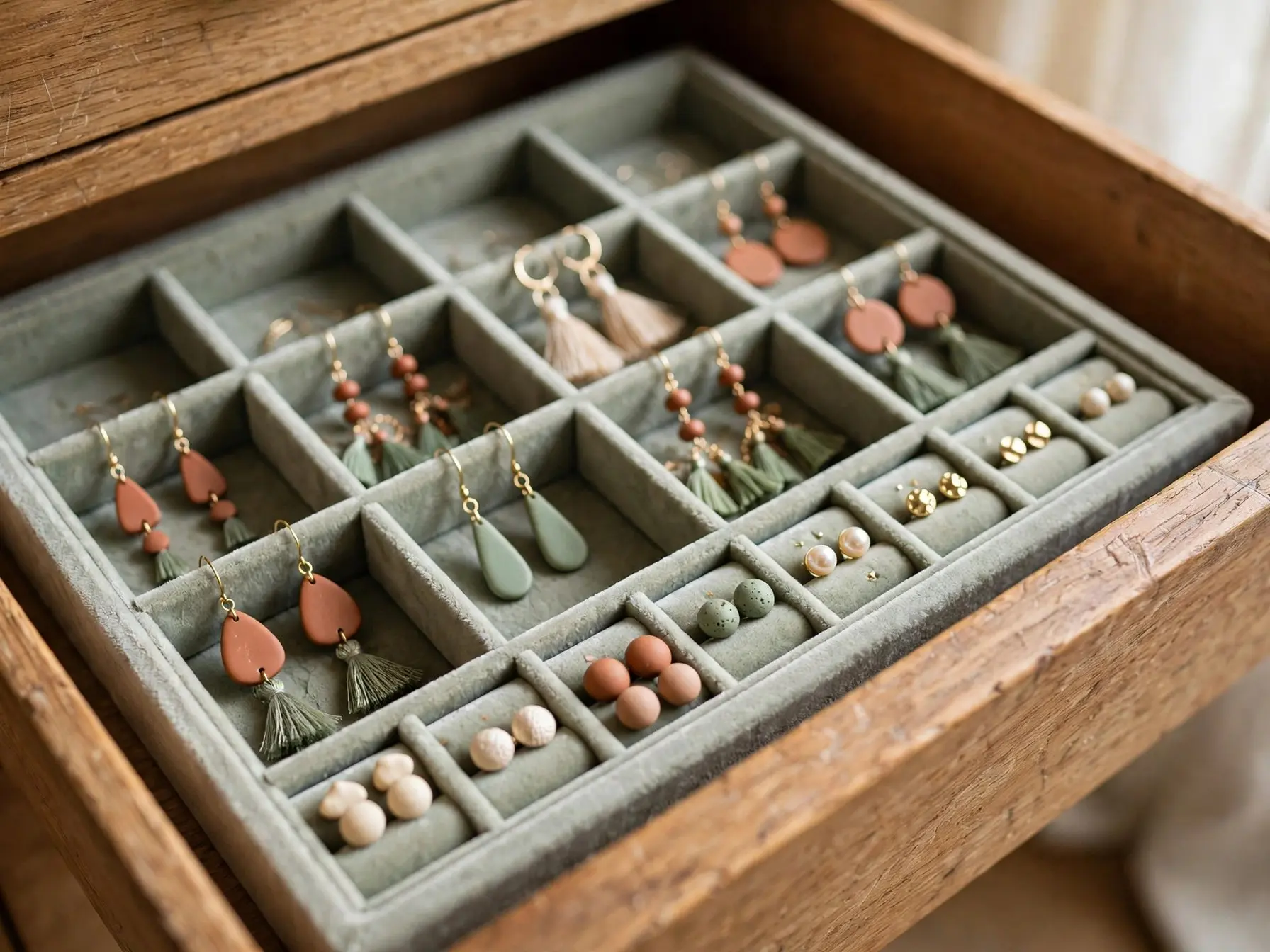
A shallow drawer is the best home for earrings, as long as it has a divided tray. One small compartment per pair keeps studs together and dangles apart, so nothing rolls to the back of the drawer or loses its match. Measure the drawer first and choose a velvet-lined tray that fits snugly — a tray that slides around is a tray that mixes pairs. Keep the daily earrings in the front row and the occasion pairs behind them, and the drawer opens onto the whole collection.
- One compartment per pair, studs together
- Measure the drawer before buying the tray
- Daily pairs in the front row
8. Stackable trays that turn one drawer into three layers
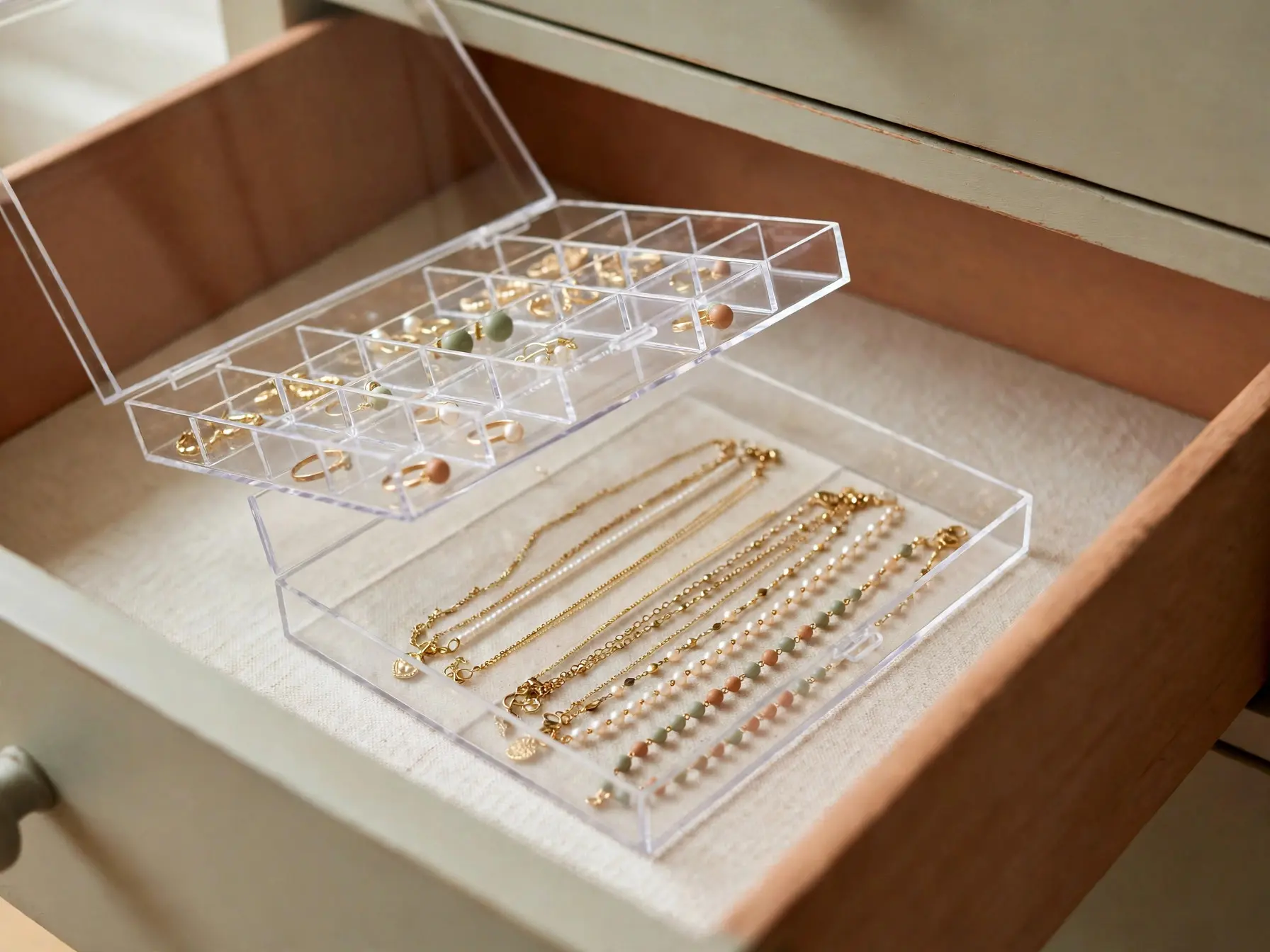
One drawer can hold three layers of jewelry if the trays stack. Clear or velvet-lined trays sit one above the other, each with its own compartments, so the drawer opens onto the daily layer and lifts to reveal the rest. Put necklaces on the bottom layer where they lie flat, earrings and rings on the top layer where they are fastest to grab, and check the drawer closes over two or three stacked trays before you buy — a tray that stops the drawer closing is worse than no tray at all. Stacking only works when each layer has its own job.
- Necklaces flat on the bottom layer, earrings on top
- Check the drawer closes over stacked trays
- Each layer has its own job
9. Velvet ring roll in the drawer for rings and small studs
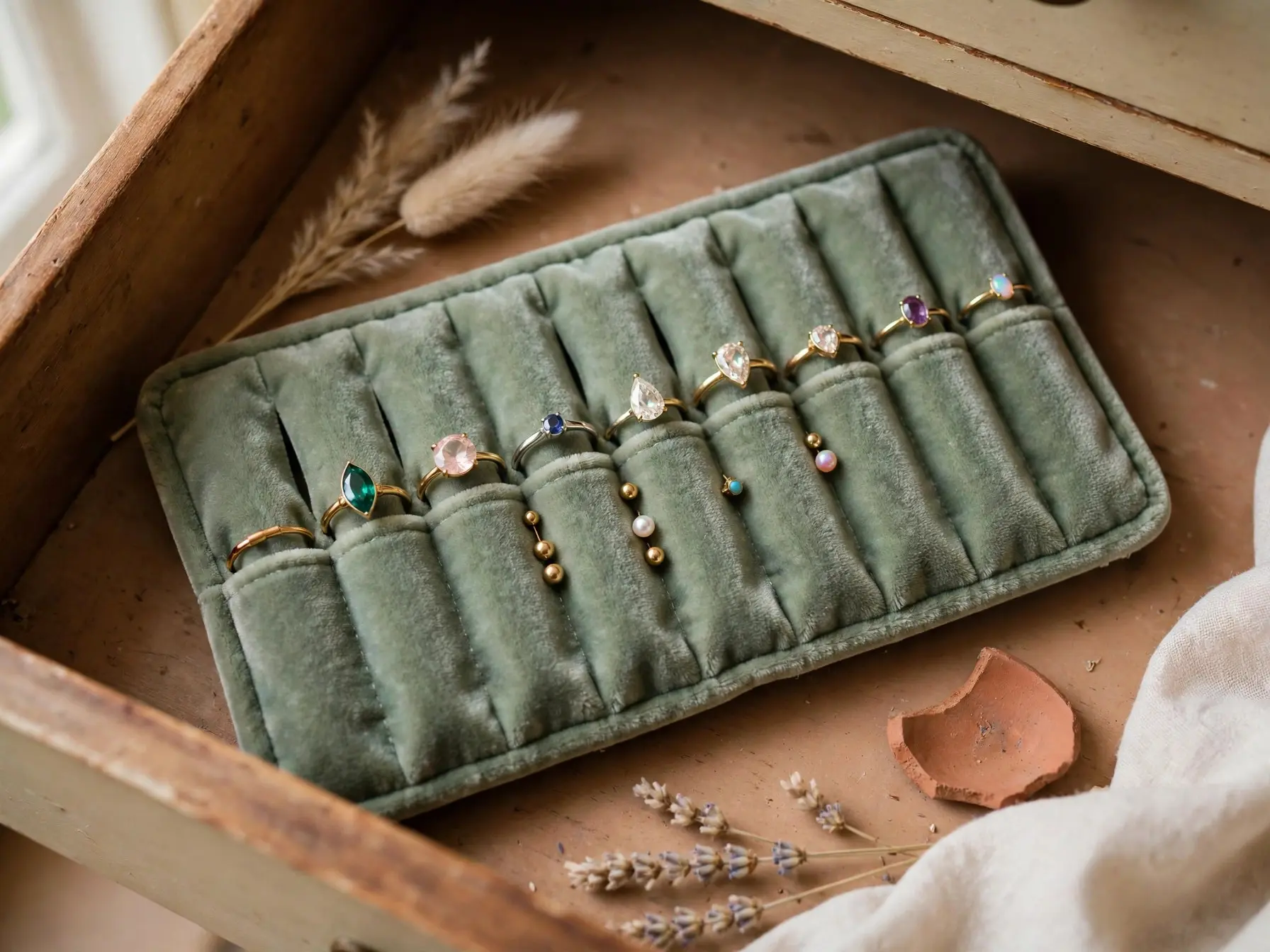
A velvet ring roll is the smallest organizer on this list and one of the most useful. The roll sits in the drawer with a slit for each ring, holding every band upright and apart so stones cannot scratch each other and no ring rolls away. It also takes small studs tucked between the slits, and it lifts out of the drawer whole — handy when you travel or want the rings on the dresser for a week. Keep the roll in the front of the drawer, where it is the first thing you see.
- One slit per ring, stones apart
- Small studs tuck between the slits
- The roll lifts out whole for travel
Behind the door: hanging organizers for small rooms
When the dresser and the drawer are both full, the door and the closet rod are the next surfaces. Hanging organizers add storage without taking a single inch of dresser.
10. Over-the-door hanging organizer with clear pockets
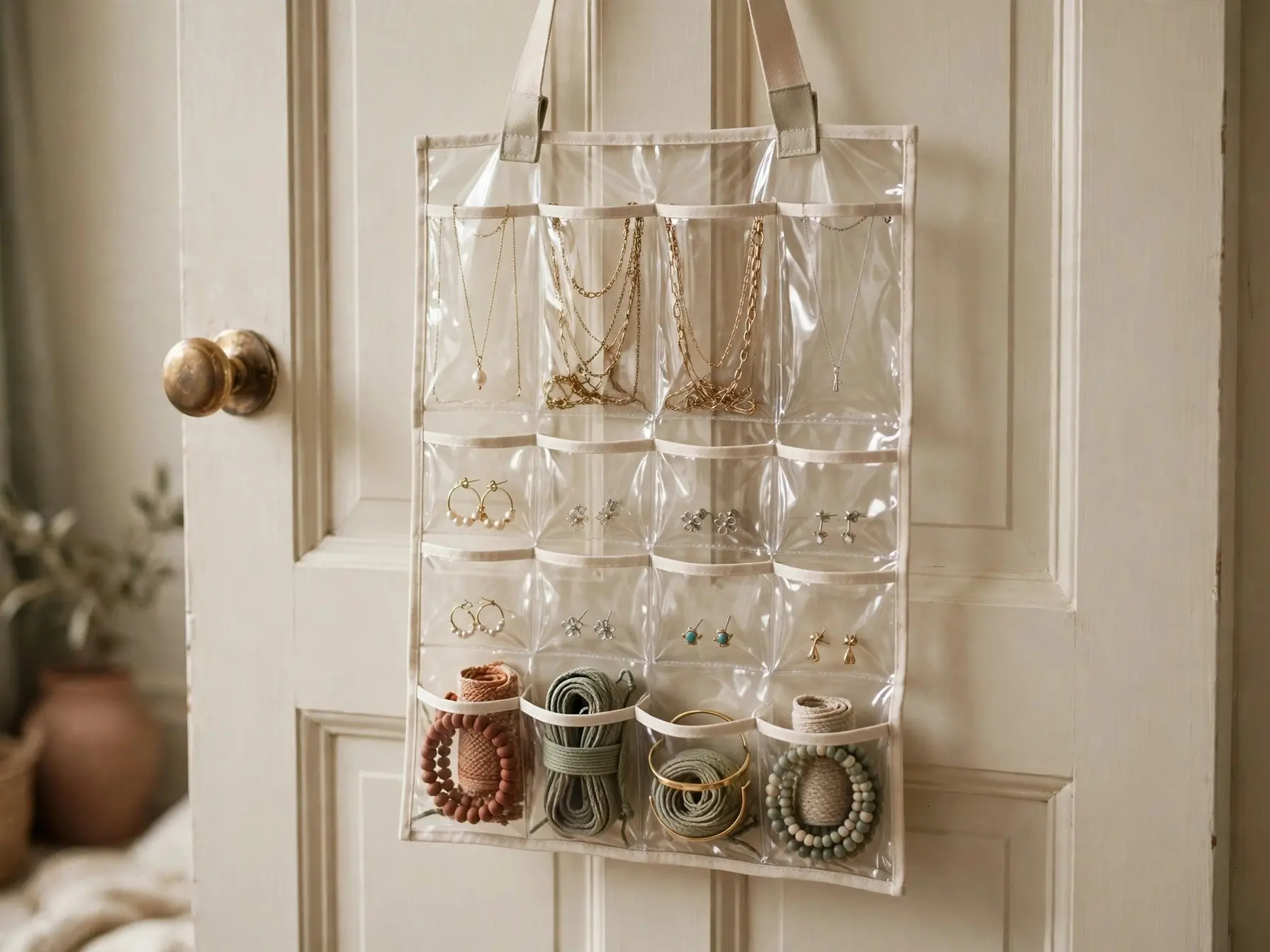
When the dresser and the drawer are both full, the back of the bedroom door is the next surface. A hanging jewelry organizer with clear pockets holds necklaces, earrings and bracelets where you can see them all at once, and it hangs on two hooks over the door — no screws, no drilling, nothing to patch when you move out. Keep necklaces in the top pockets where they hang straight, earrings paired in the small pockets, and bracelets rolled in the bottom ones. It is the most renter-friendly storage on this list.
- Necklaces in the top pockets, earrings paired below
- Hangs over the door — no screws, no drilling
- Clear pockets so nothing gets bought twice
11. Hanging necklace organizer on a closet rod
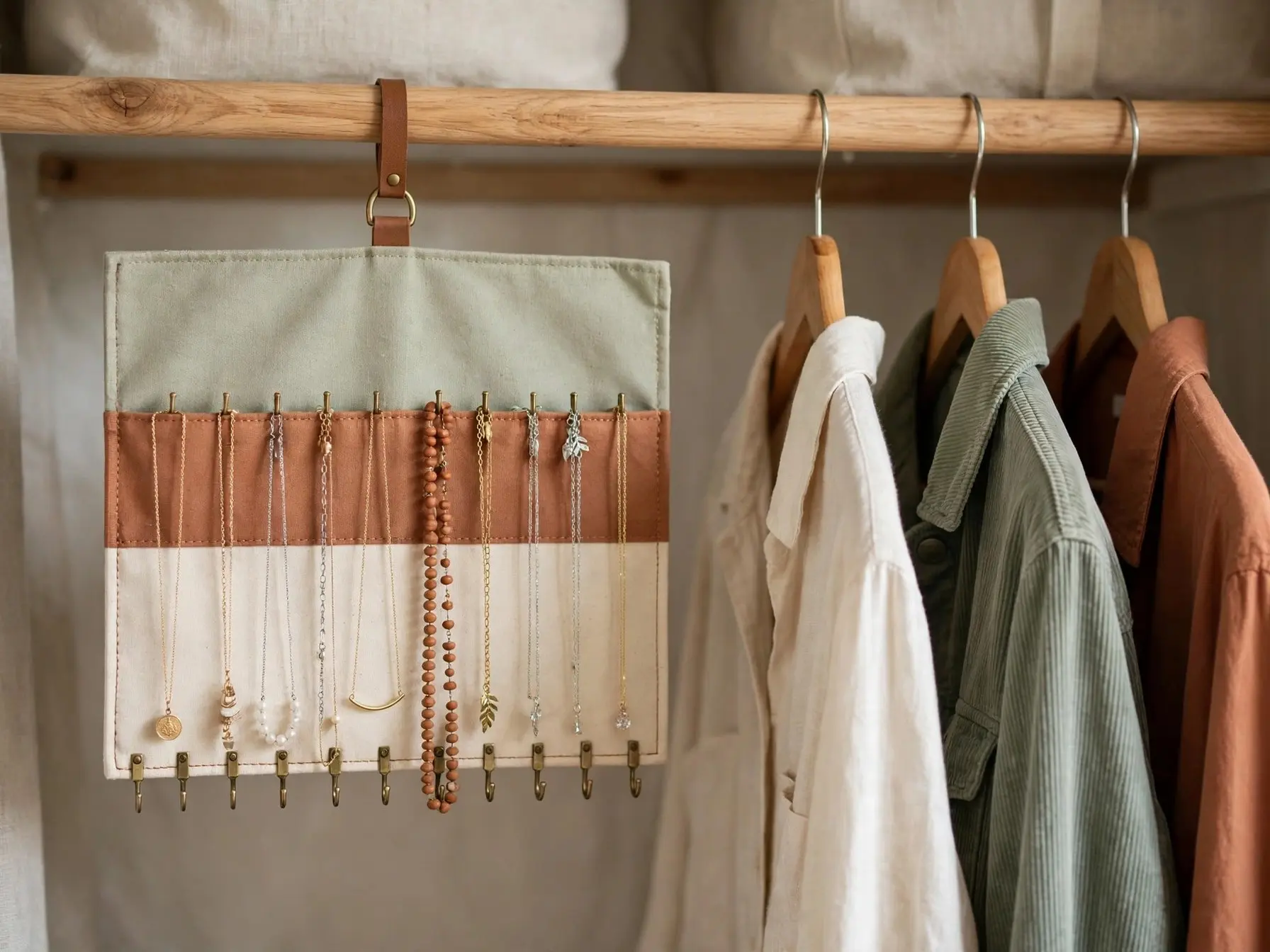
A hanging organizer that hooks onto a closet rod keeps necklaces with the outfits they go with. The organizer has a row of small hooks or a strip of pockets that hang from the rod beside the clothes, so each necklace is visible when you choose what to wear — and each one hangs straight, away from the others, so chains cannot tangle. It takes no dresser space at all, which makes it the right pick for a bedroom with no vanity. Slip it onto the rod and the closet does double duty.
- Necklaces hang beside the outfits they match
- Each chain hangs straight, away from the others
- Takes no dresser space at all
For travel: rolls and pouches that stop tangles on the move
Travel jewelry is a separate system, not a smaller copy of the dresser. A roll and a zip pouch cover a weekend away and a flight, with every piece in its own pocket.
12. Jewelry travel roll with individual pockets
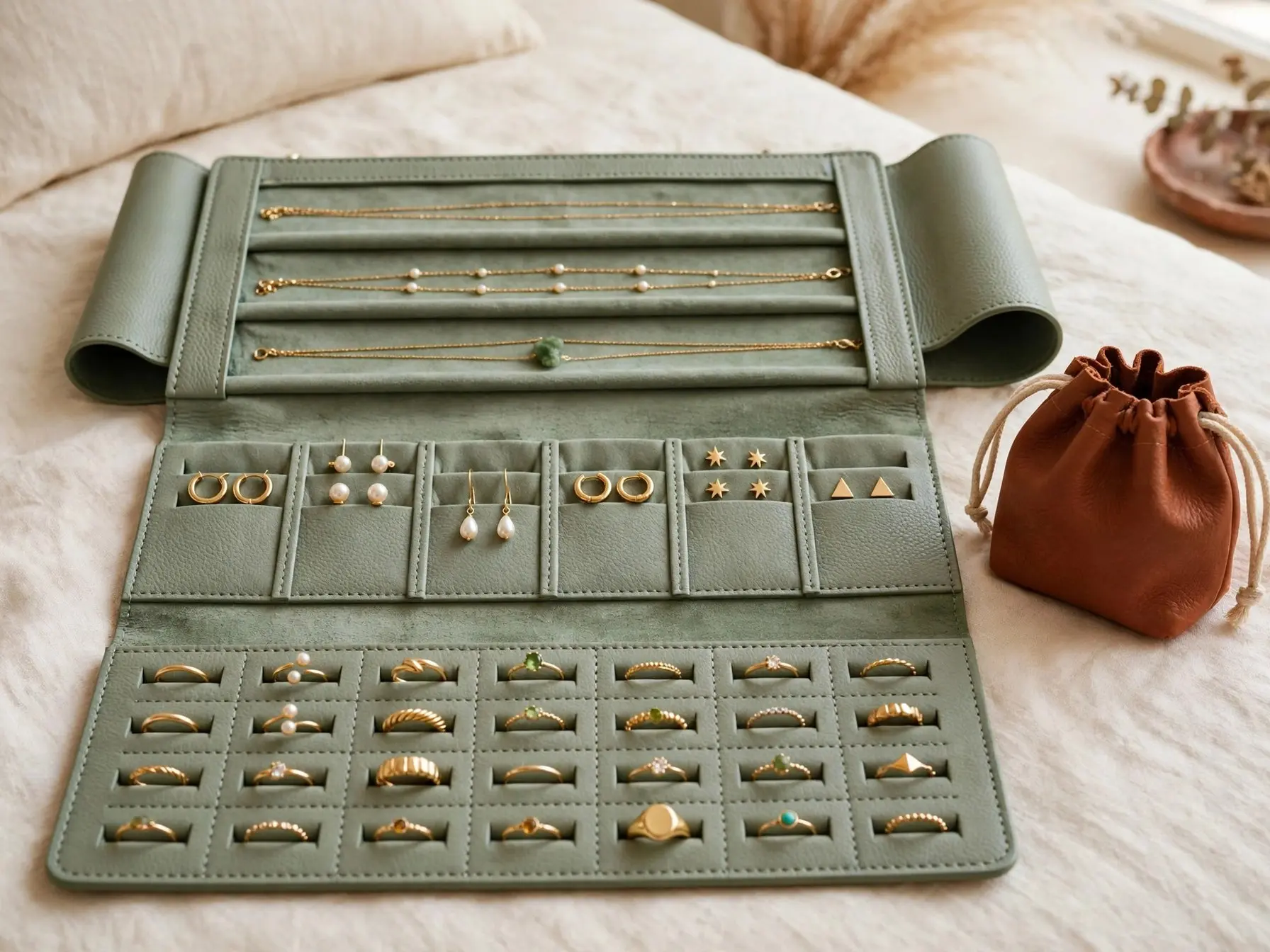
A travel roll is a jewelry box that rolls up small enough for a carry-on. Unroll it and each piece has its own pocket or slot — necklaces in separate lanes, earrings paired, rings in slits — so nothing touches anything else on the journey. Fasten every clasp before you roll it, and keep the roll flat in the bag rather than stuffed in a side pocket, where it gets crushed. At the hotel, unroll it on the dresser and it is the vanity for the trip.
- One pocket or slot per piece
- Fasten every clasp before rolling it up
- Keep the roll flat in the bag, never crushed
13. Small zip pouch kit for the carry-on
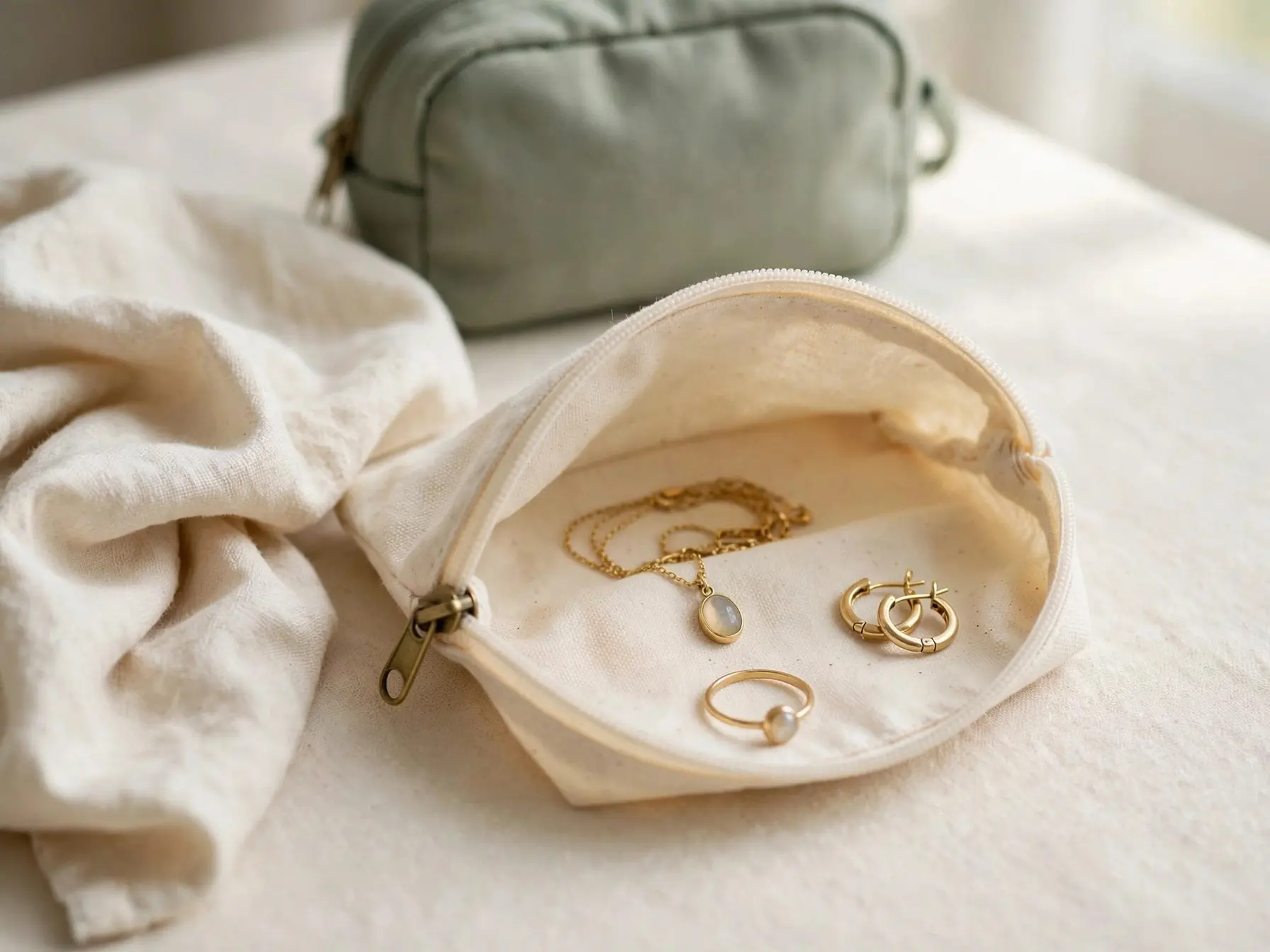
For a weekend trip, a small zip pouch is the travel version of the daily tray: it holds only what the trip needs, and nothing else. Pack one necklace, one pair of earrings and one ring — the pieces that match the outfits you packed — plus a soft cloth to wrap the silver in. A pouch that closes flat is the sign you packed right. Keep one pouch ready in the drawer so a weekend trip needs no repacking at all, and never toss loose jewelry into a bag pocket, where chains knot in minutes.
- One necklace, one pair of earrings, one ring
- Wrap silver in a soft cloth inside the pouch
- A pouch that closes flat means you packed right
The anti-tarnish rules that keep silver bright
Tarnish is not dirt — it is silver reacting with air and moisture. These six rules slow that reaction to a crawl, and they cost nothing: pouches, a dry spot and a quick wipe are the whole system.
| Rule | Why it works |
|---|---|
| Keep silver in anti-tarnish pouches or cloth | Sealed pouches slow the air exposure that turns silver dark |
| Never store jewelry in the bathroom | Steam and humidity speed tarnish on silver and dull plated pieces |
| One piece per slot, hook or pocket | Pieces stored apart cannot scratch or tangle each other |
| Wipe each piece before putting it away | Skin oils, lotion and perfume residue speed tarnish |
| Fasten clasps before you store a chain | A closed chain cannot knot itself around its neighbours |
| Keep pearls and soft stones in their own soft pouch | Pearls scratch easily and need their own protected spot |
Silver that already tarnished is not ruined: a silver polishing cloth brings back the shine in minutes. What the rules protect is the next tarnish — keep the pieces dry and apart, and the cloth stays in the drawer.
Questions, answered
How do you store necklaces so they don’t tangle?
Hang each necklace on its own hook, or lay it flat in its own slot in a divided tray. Fasten the clasp before you store it — a closed chain cannot knot itself — and never pile necklaces in a single heap in a drawer. For travel, lay each chain in its own pocket in a travel roll.
Should jewelry be stored in the bathroom?
No — bathroom steam and humidity speed tarnish on silver and dull plated pieces. Keep the bulk of your jewelry in a cool, dry drawer or on a dresser in the bedroom, with only the daily pieces in the bathroom if you must. If a piece does live in the bathroom, keep it in a closed box or pouch away from the shower.
What is the best jewelry storage for a small drawer?
A shallow divided tray that fits the drawer exactly, with one slot per piece. Earrings go paired in small compartments, rings in slots or on a velvet roll, and necklaces laid flat in their own lanes. Measure the drawer first — a tray that fits snugly cannot slide, and stackable trays double the space.
How do you stop silver jewelry from tarnishing in storage?
Keep silver in anti-tarnish pouches or wrapped in anti-tarnish cloth, in a cool, dry place away from the bathroom. Wipe each piece before putting it away, since skin oils speed tarnish, and add a silica gel packet to the box to absorb moisture. A piece that already tarnished can be cleaned with a silver cloth — never use a dip on plated pieces.
Keep reading
Jewelry is only one small-space problem — the closet around it needs the same treatment. Our guide to closet organization ideas finds room on every shelf and rail, storage ideas for small spaces hides the overflow the dresser cannot hold, and how to organize anything covers the whole-room system. Start with the jewelry, then let the system spread.
Thirteen ideas, five spots, one habit: store each piece separated and visible, and keep silver dry. Start with the daily stand — necklaces on hooks, rings in slots — and the rest of the collection follows.