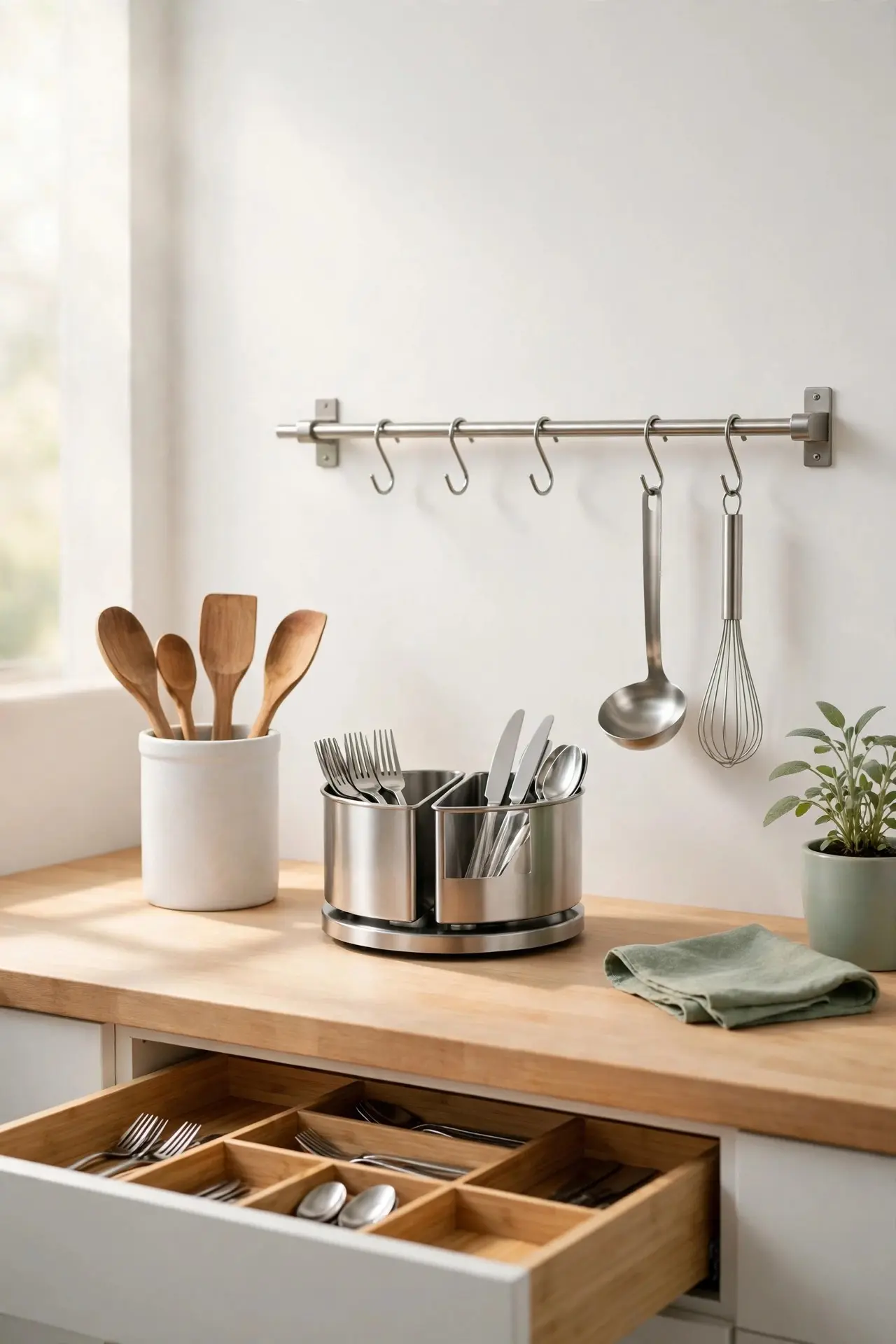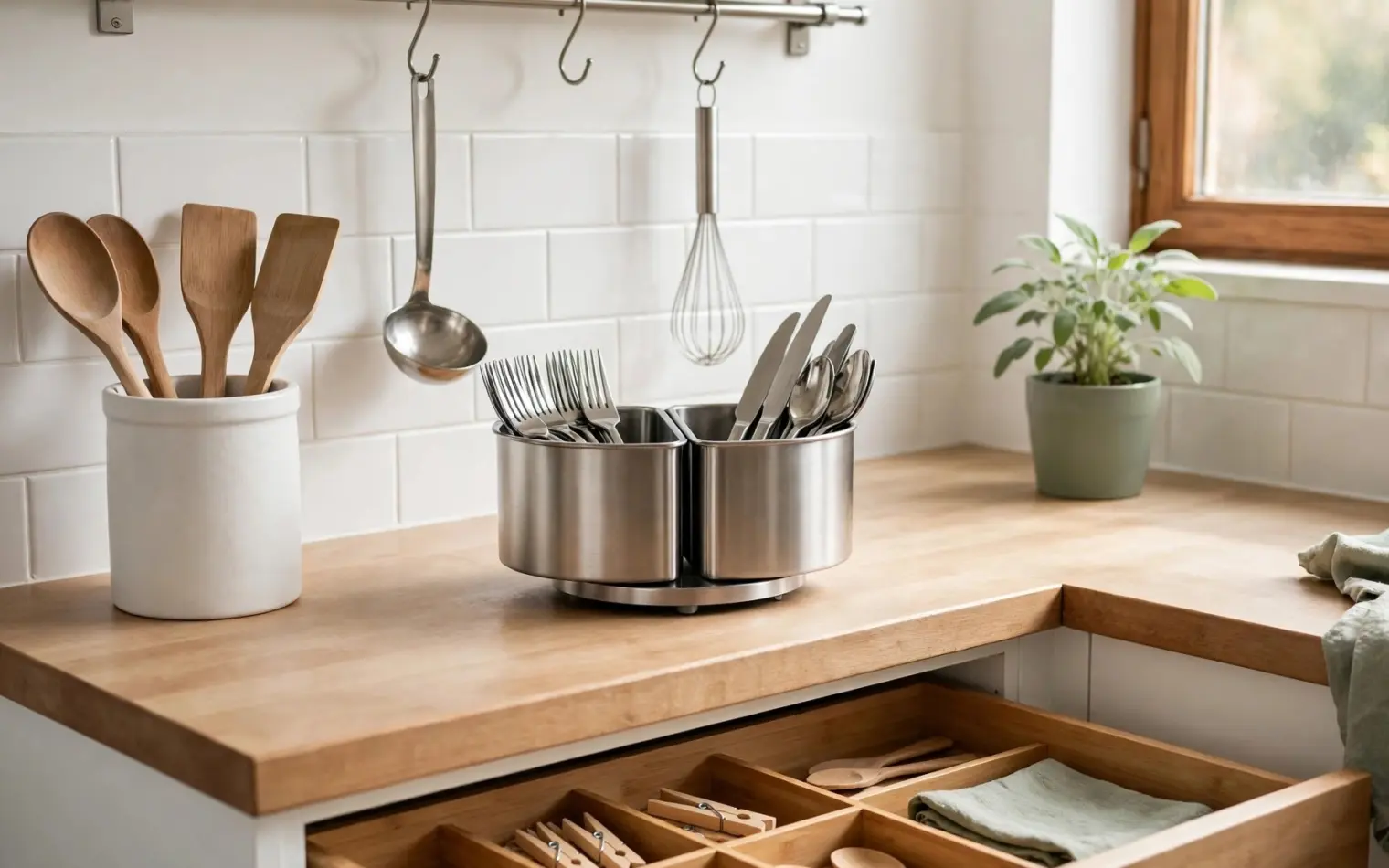
The best kitchen utensil holder for most kitchens is a stainless wall rail with S-hooks: it holds 8 to 12 tools, costs about $15 to $30, and uses no counter space at all. If you would rather keep tools out of sight, an expandable bamboo drawer tray is the next best pick, and a rotating caddy wins when the stove is where you cook most.
Thank you for reading this post, don’t forget to subscribe!Utensils end up in a jammed crock for one reason: the holder does not fit the kitchen. This guide sorts 21 kitchen utensil holders by the space they need, from wall rails that use no counter at all to drawer trays that hide everything away, so you can skip straight to the ones that work in yours. Our guide to kitchen organization ideas covers the whole room; here we zoom in on utensils alone, with a comparison table up front so you can pick in minutes.
How we chose
Every holder on this list fits a real kitchen, not a showroom. We picked holders that hold the tools people actually cook with, cost under $45, and come in a type for every kitchen size, from a studio with no counter to a shared kitchen that feeds a crowd. Renter-friendly options that need no drilling are marked in each pick, and every price band is a typical street price, not a sale price.
What to measure first
Measure before you buy anything: the counter depth where a crock or caddy would sit, the width and depth of the drawer for a tray, the open wall above the backsplash for a rail, and the flat side of the fridge for a magnetic holder. A holder that is wider than its spot will never fit, whatever it costs.
Which utensil holder fits your kitchen?
Find your kitchen in the table first, then jump to the picks that fit it. The holders that use no counter at all come first, since they work in the smallest kitchens.
| Holder type | Counter space it needs | Utensils it holds | Best for | Price band |
|---|---|---|---|---|
| Wall rail with S-hooks | None — it hangs on the wall | 8 to 12 tools | Tiny kitchens and renters | $15–$30 |
| Magnetic side-of-fridge holder | None — it sticks to the fridge | 6 to 8 tools | Studios and apartments | $12–$25 |
| Adhesive wall rail | None — it sticks to the backsplash | 6 to 10 tools | Renters who cannot drill | $10–$20 |
| Tension rod under the cabinet | None — it hangs under a cabinet | 4 to 6 tools | Galley kitchens | $8–$15 |
| Expandable bamboo drawer tray | None — it lives in a drawer | 10 to 15 tools | Kitchens with a spare drawer | $15–$30 |
| Ceramic utensil crock | About 5 to 6 in of counter | 8 to 12 tools | Classic kitchens with counter room | $12–$30 |
| Rotating utensil caddy | About 7 in of counter | 10 to 15 tools | Everyday cooking by the stove | $15–$35 |
| Two-tier rotating caddy | About 8 in of counter | 15 to 20 tools | Big households and shared kitchens | $20–$40 |
| Flatware caddy with handles | About 8 in, and it moves off the counter | 12 to 16 pieces | Parties and holiday dinners | $15–$30 |
Prices move around, but the sizes do not: a holder that is wider than its spot will never fit, whatever it costs. Measure first, then buy.
Four all-rounders that work in almost any kitchen
If you only read one section, read this one. These four holders cover the most common kitchens: a rail for tiny counters, a tray for hidden storage, a caddy for cooks who live at the stove, and a magnetic holder for the fridge side.
1. The stainless wall rail with S-hooks
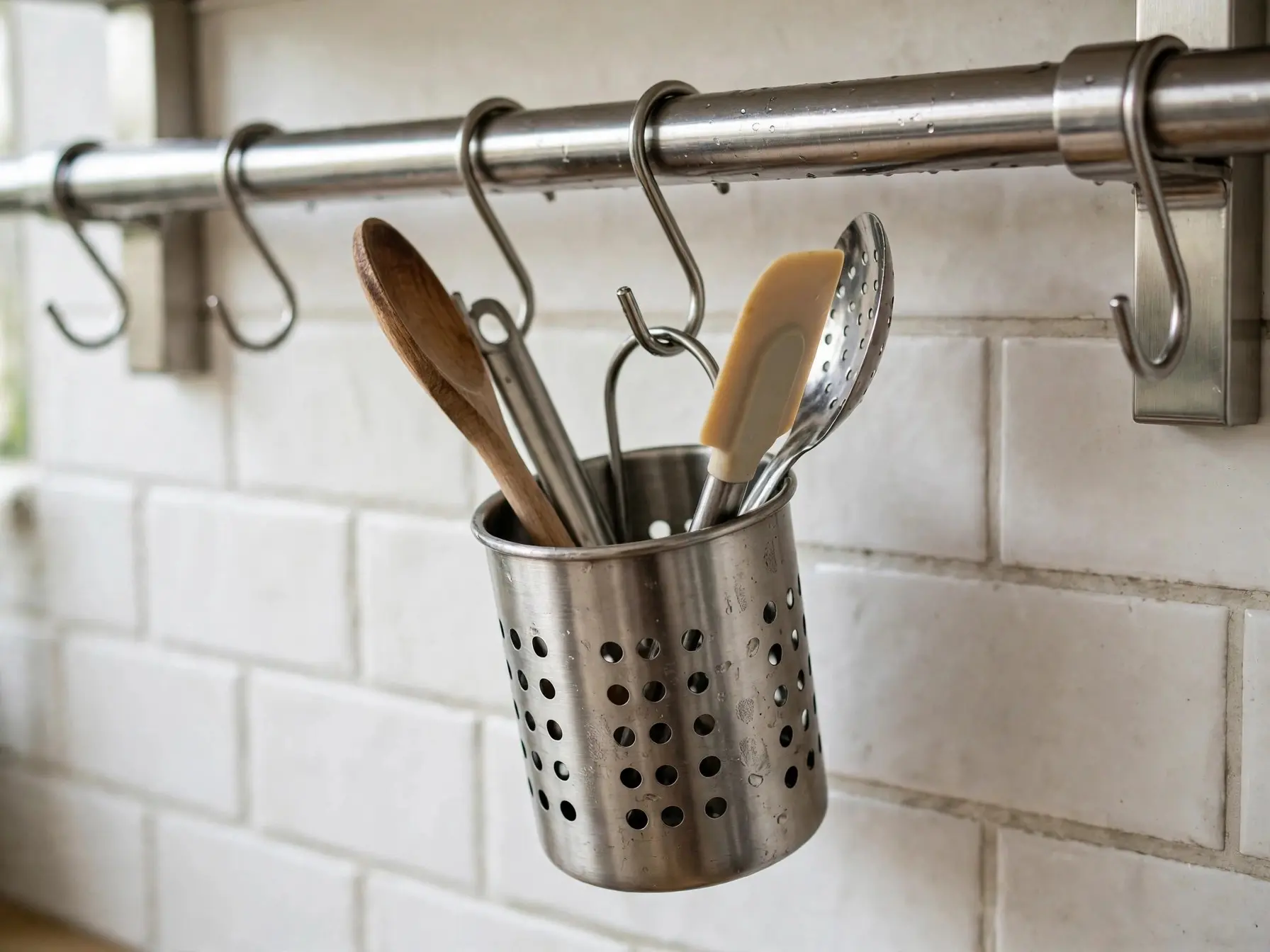
A wall rail takes every ladle, whisk and spatula off the counter in one move. Mount it at eye level above the backsplash, hang the tools you reach for daily on S-hooks, and the whole counter is clear for chopping and prep. Stainless steel wipes clean of grease and steam, and the hooks slide along the rail, so the layout changes in seconds when your cooking changes.
Hang the daily tools at the front of the rail and the once-a-month tools at the ends.
Our pick
Stainless Wall Rail With S-Hooks
A tiny kitchen where the counter is already full.
Pros: Frees the whole counter with no floor or drawer space used; S-hooks slide along the rail, so the layout changes in seconds; Stainless steel wipes clean of grease and steam
Cons: Needs a wall stud or solid anchor for a heavy load; Open storage shows every tool, so it suits tidy cooks
2. The expandable bamboo drawer tray
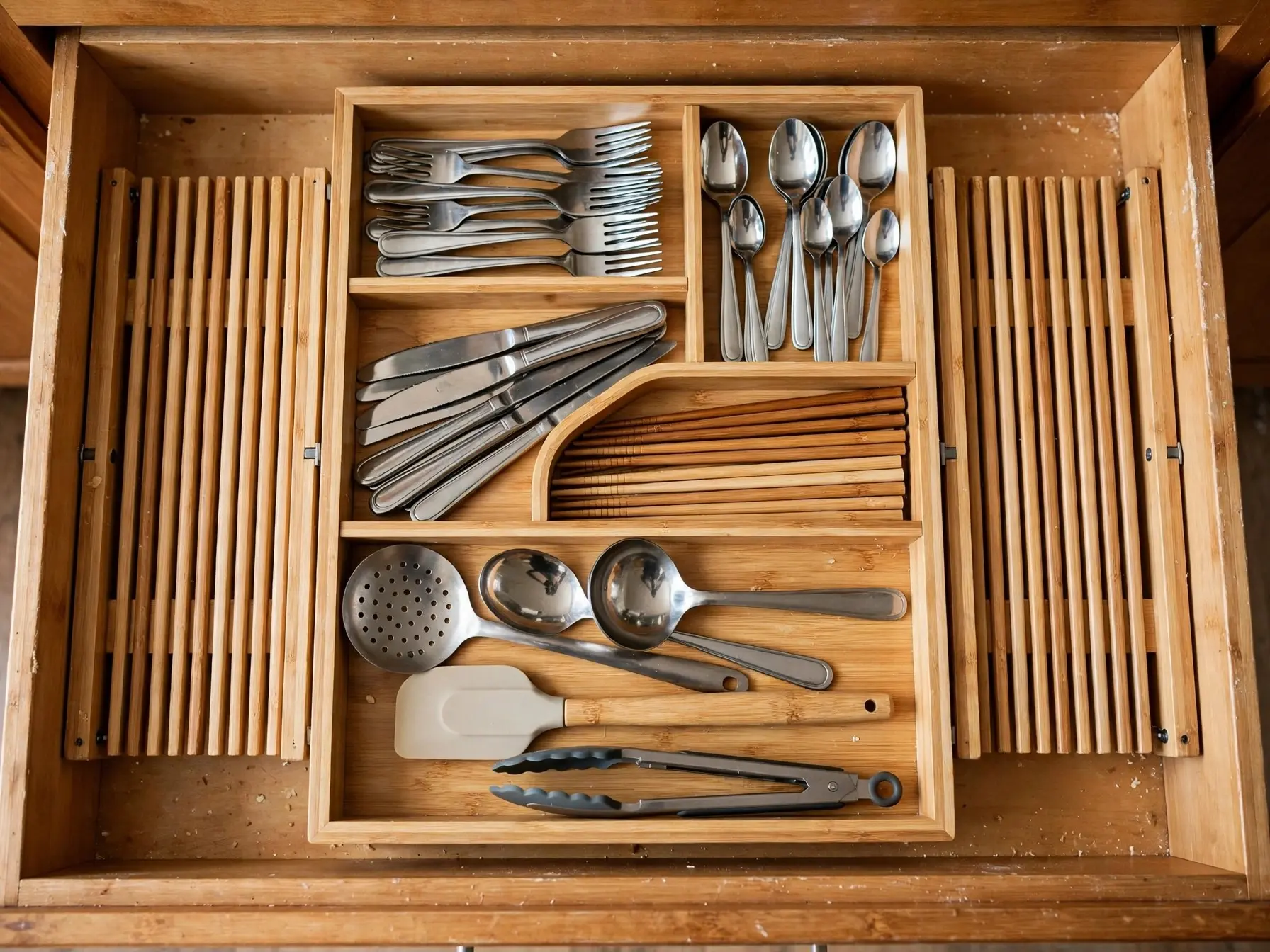
A bamboo tray turns a junk drawer into the utensil drawer. It expands to fit the drawer you have, from about 13 to 22 inches wide, and its slots sort spatulas, tongs and serving spoons so nothing tangles. The tools stay out of sight, the counter stays clear, and bamboo resists moisture far better than raw wood.
Measure the drawer first: width, depth and height, since deep ladles need a deep drawer.
Our pick
Expandable Bamboo Drawer Tray
Kitchens with a spare drawer near the stove.
Pros: Expands to fit drawers from 13 to 22 inches wide; Bamboo resists moisture and wipes clean; Keeps the counter completely clear
Cons: Takes a whole drawer, so small kitchens may miss the space; Deep ladles may not lie flat in shallow drawers
3. The rotating utensil caddy by the stove
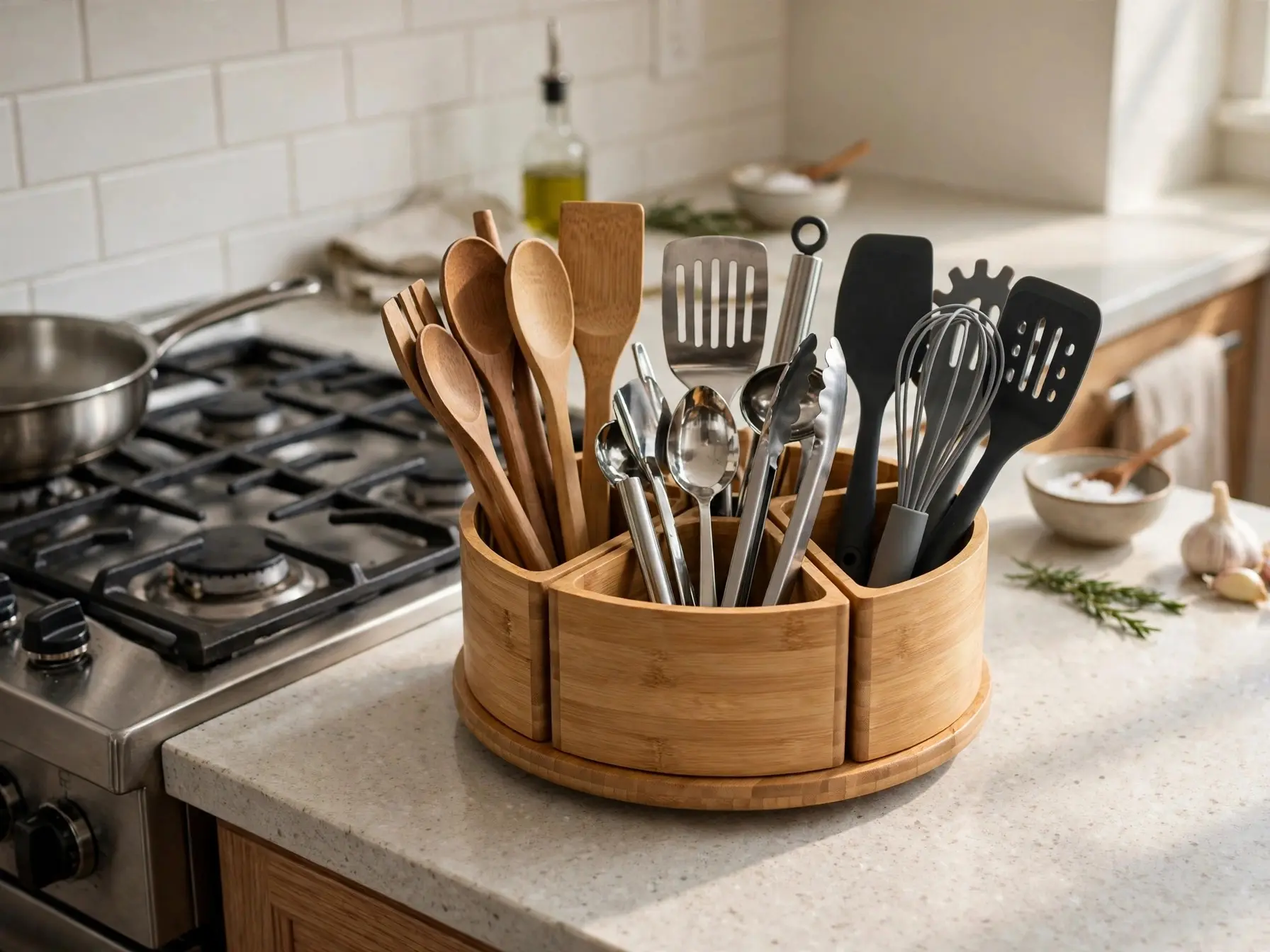
A rotating caddy sits beside the stove and spins, so the tool you want is one turn away instead of buried at the back of a crock. Divided compartments keep tongs from tangling with spatulas, and a heavy base stays put when you pull a tool out mid-stir. It takes about 7 inches of counter, which is the trade for never digging again.
Keep only the five to eight tools you use daily in the caddy, and move the rest to a drawer tray.
Our pick
Rotating Utensil Caddy
Everyday cooking when the stove is the center of the kitchen.
Pros: Spins, so the tool you want is one turn away; Divided compartments keep tongs from tangling with spatulas; Heavy base stays put when you pull a tool out
Cons: Tall tools can tip the caddy if it is loaded on one side; Takes about 7 inches of counter beside the stove
4. The magnetic side-of-fridge holder
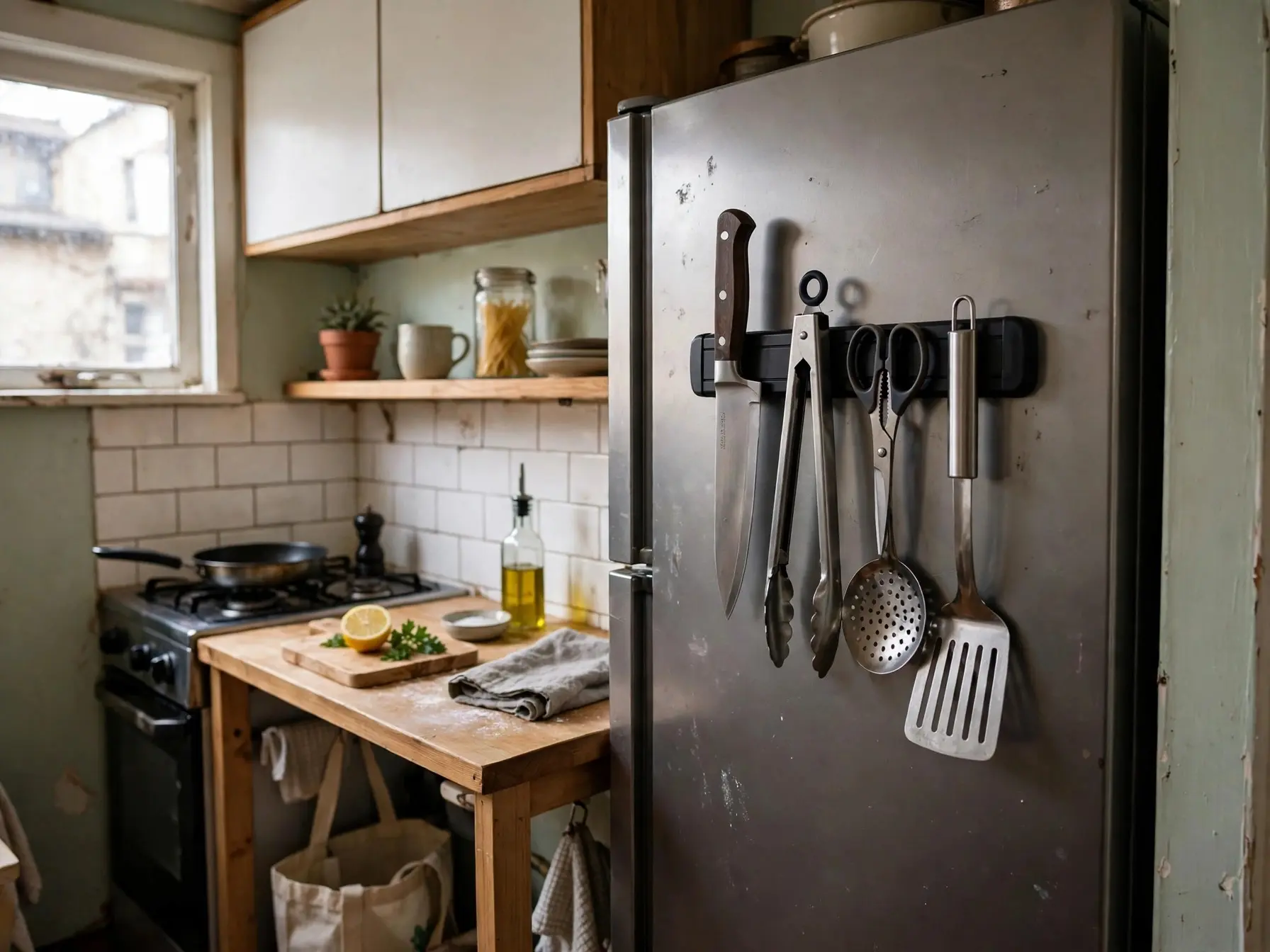
The side of the fridge is the most wasted surface in a small kitchen, and a magnetic holder puts it to work. Strong magnets grip the steel, no drilling and no adhesive, and the holder moves in seconds if the layout changes. It holds six to eight everyday tools at arm’s reach from the stove, which is plenty for a studio cook.
Test the magnets on your fridge first: textured finishes grip less well than smooth steel.
Our pick
Magnetic Side-of-Fridge Utensil Holder
Studio apartments where the fridge side is free wall space.
Pros: Uses the side of the fridge, a surface most kitchens waste; Moves in seconds with no holes or adhesive; Keeps tools at arm's reach from the stove
Cons: Strong magnets can slide on textured fridge finishes; Holds fewer tools than a rail or a crock
Countertop crocks and rotating caddies
Crocks and caddies are the classic pick when the counter has room. The difference is sorting: a crock holds everything in one open top, while a caddy divides tools so nothing tangles.
5. The classic ceramic utensil crock
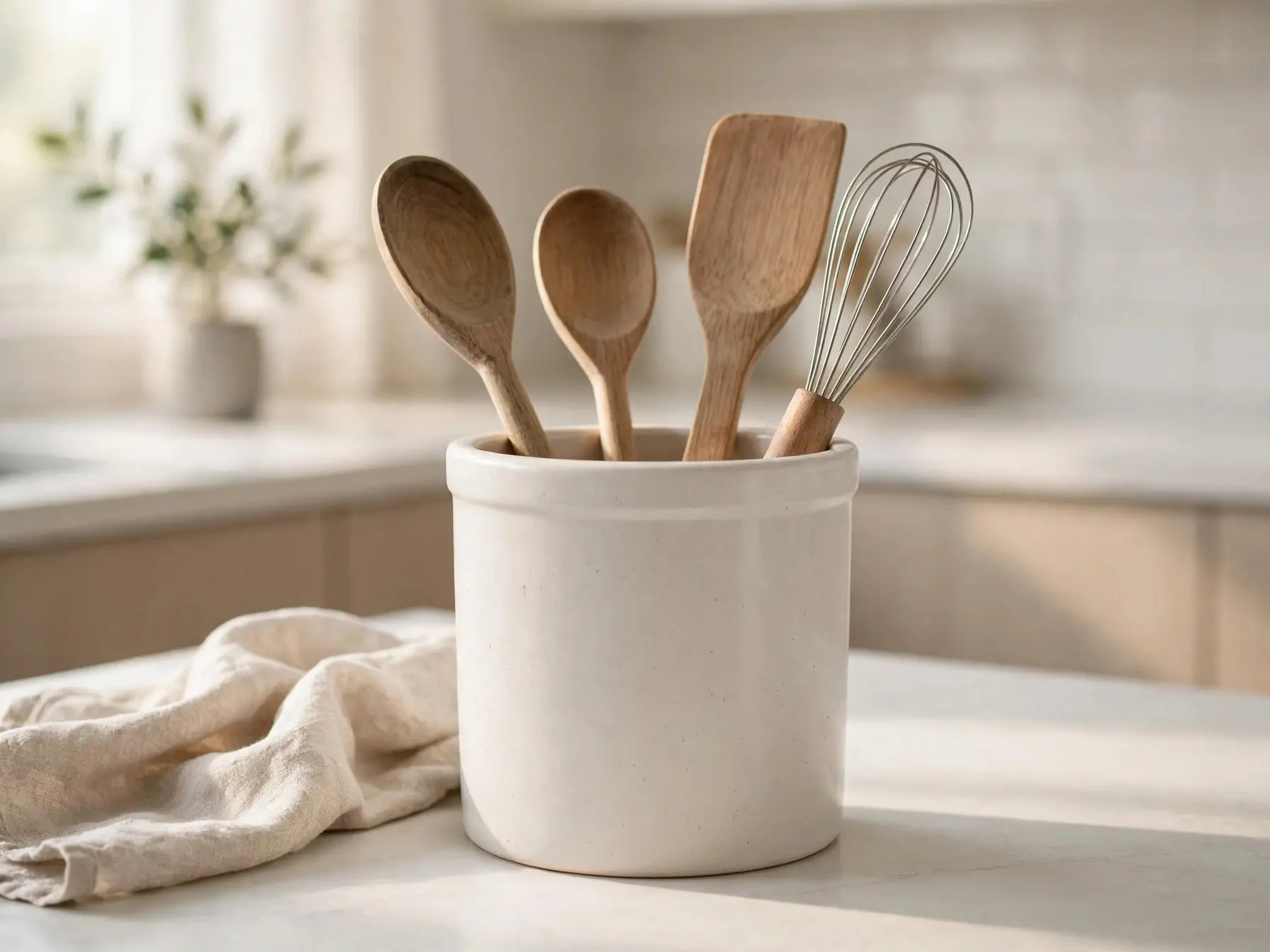
The ceramic crock is the classic for a reason: a heavy base that will not tip when you grab a tool, a wide mouth that makes every handle easy to reach, and a look that suits almost any kitchen. Pick one about 5 to 6 inches across, which holds eight to twelve tools without crowding, and keep it near the stove so the daily tools are always in reach.
If the crock slides on the counter, stick a small circle of shelf liner under the base.
Our pick
Classic Ceramic Utensil Crock
A classic kitchen with a little counter to spare.
Pros: Heavy base keeps it steady when you grab a tool; Ceramic wipes clean and never rusts; Looks at home in almost any kitchen style
Cons: Breakable if it slides off the counter; Holds fewer tools than a divided caddy
6. The two-compartment ceramic crock
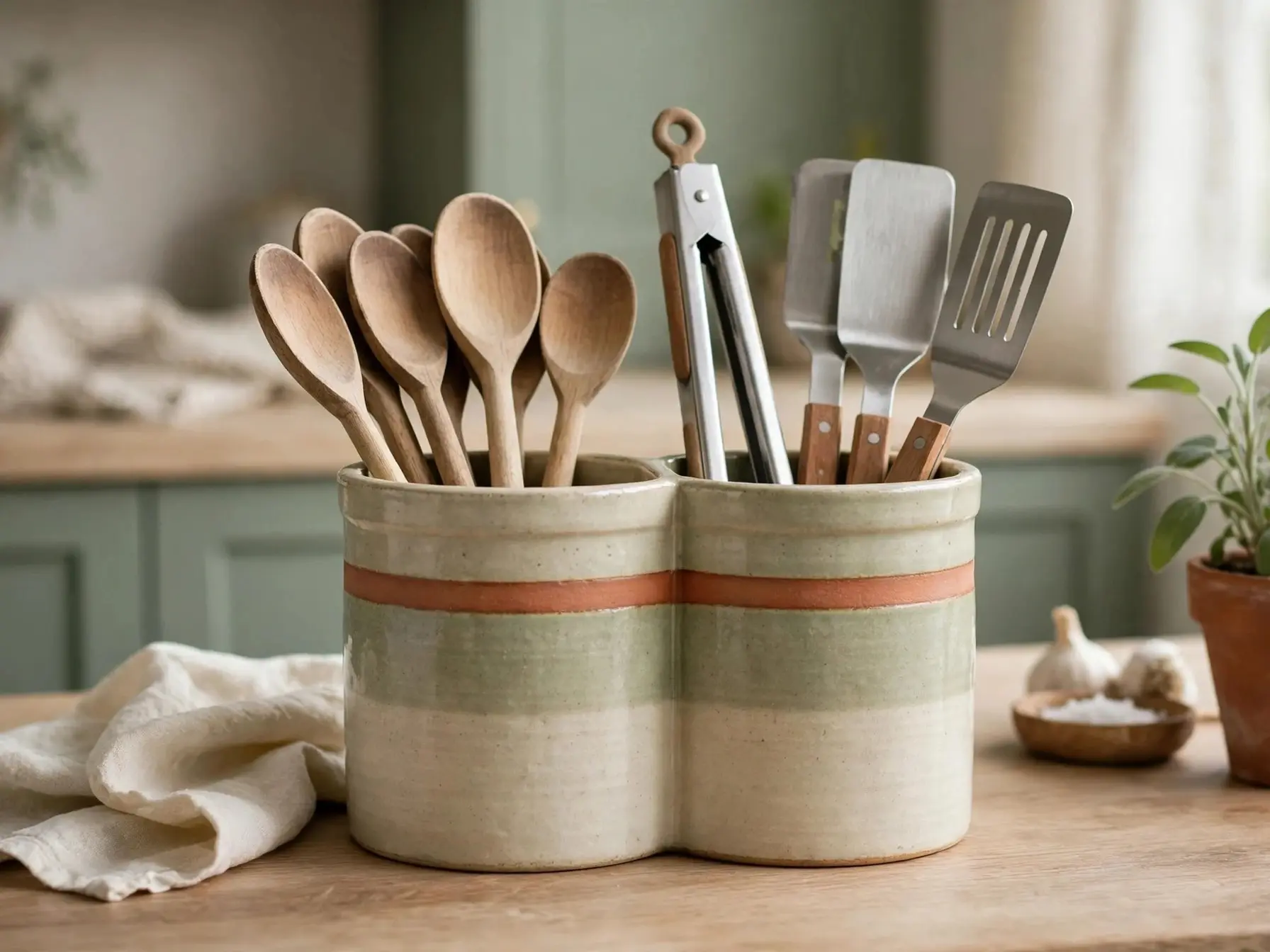
A divider down the middle is the one change that fixes the classic crock’s only flaw: tools tangling into a knot. Wooden spoons go on one side, metal tongs and spatulas on the other, and you can see every handle at a glance. It keeps the same heavy, tip-proof base as a single crock, with a little more order inside.
Put the tools you grab with wet hands on the side nearest the sink.
Our pick
Two-Compartment Ceramic Crock
Cooks who want the crock look with a little sorting built in.
Pros: The divider keeps wooden and metal tools from tangling; Same heavy, tip-proof base as a classic crock; Two sections make it easy to find the right tool
Cons: Each compartment fits fewer tools than a single open crock; The divider makes the inside harder to wipe
7. The stainless steel utensil crock
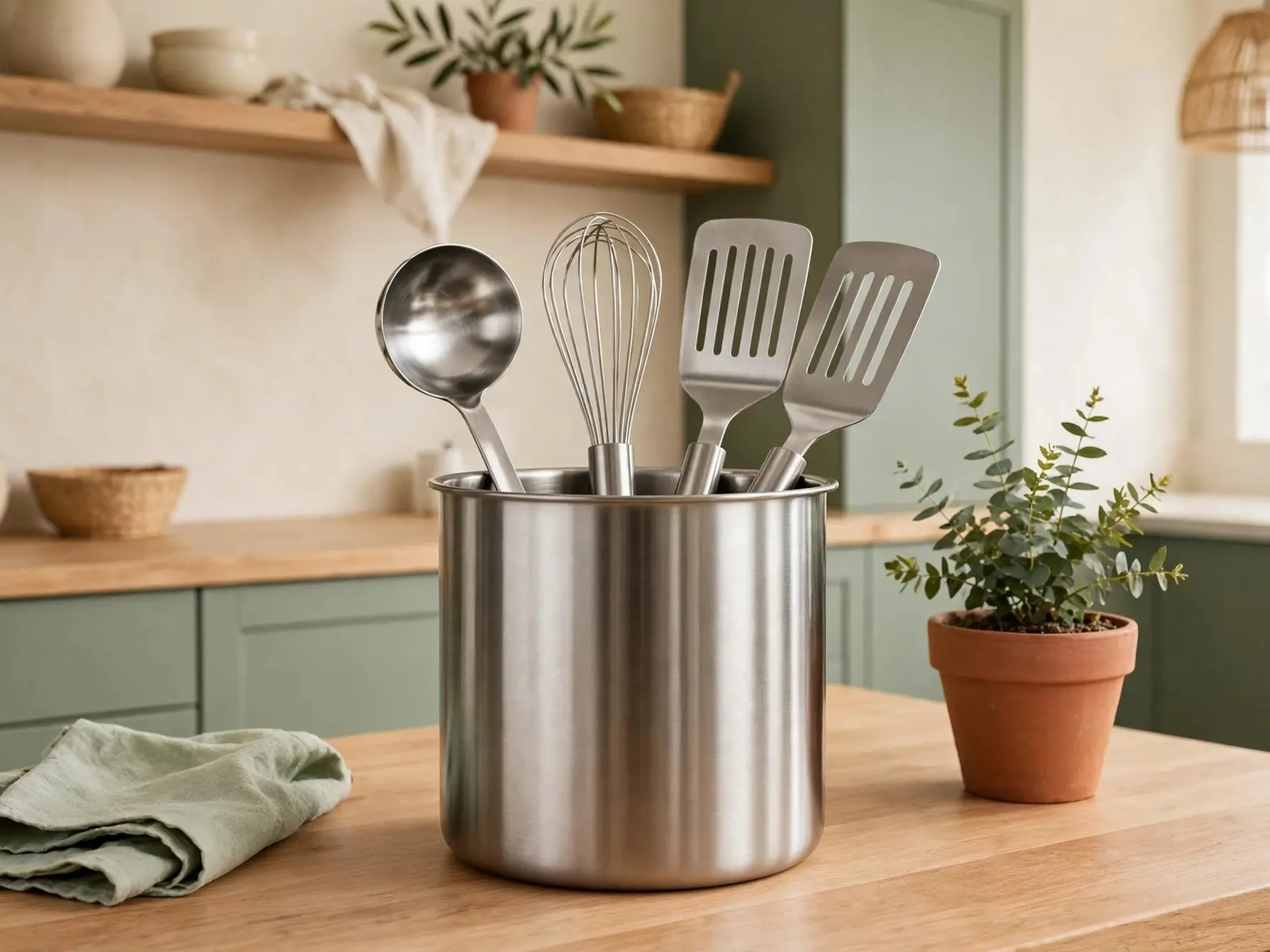
A steel crock matches stainless appliances and never chips, cracks or stains, which makes it the practical pick for a hard-working kitchen. It wipes clean in seconds after messy cooking, and its slim profile fits narrow counter spots where a wide ceramic crock would crowd the stove. The only upkeep is a quick wipe for fingerprints.
Pick a weighted base: light steel crocks can tip when you pull a heavy ladle out fast.
Our pick
Stainless Steel Utensil Crock
Modern kitchens where the appliances are stainless steel.
Pros: Matches stainless appliances and never chips or cracks; Wipes clean in seconds after messy cooking; Slim profile fits narrow counter spots
Cons: Shows fingerprints and water spots; Lightweight versions can tip when pulled hard
8. The turned-wood utensil crock
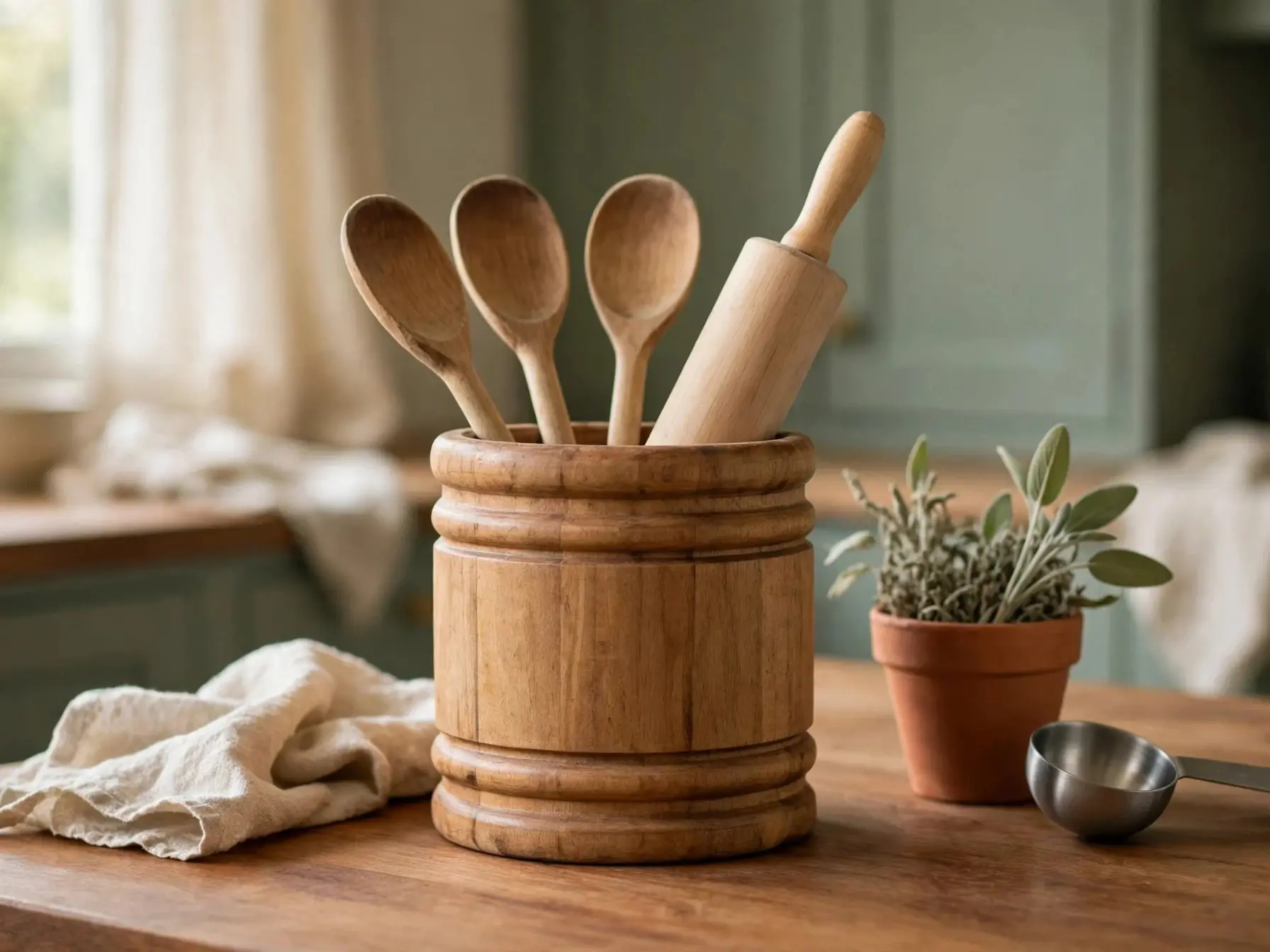
A turned-wood crock brings warmth to a white or steel kitchen, and wood is gentle on nonstick pans and ceramic coatings in a way metal is not. The wide mouth makes every tool easy to grab, and the grain hides the odd splash far better than glazed ceramic. Keep it away from the sink splash zone and oil it now and then so it never dries out.
Rub in a little food-safe mineral oil once a month to keep the wood from cracking.
Our pick
Turned-Wood Utensil Crock
Warm, wood-toned kitchens and cooks who love wooden tools.
Pros: Warm wood tone softens a white or steel kitchen; Gentle on nonstick pans and ceramic coatings; Wide mouth makes it easy to grab a tool
Cons: Needs oiling now and then to stop it drying out; Stains if it sits in a wet spot
9. The two-tier rotating caddy
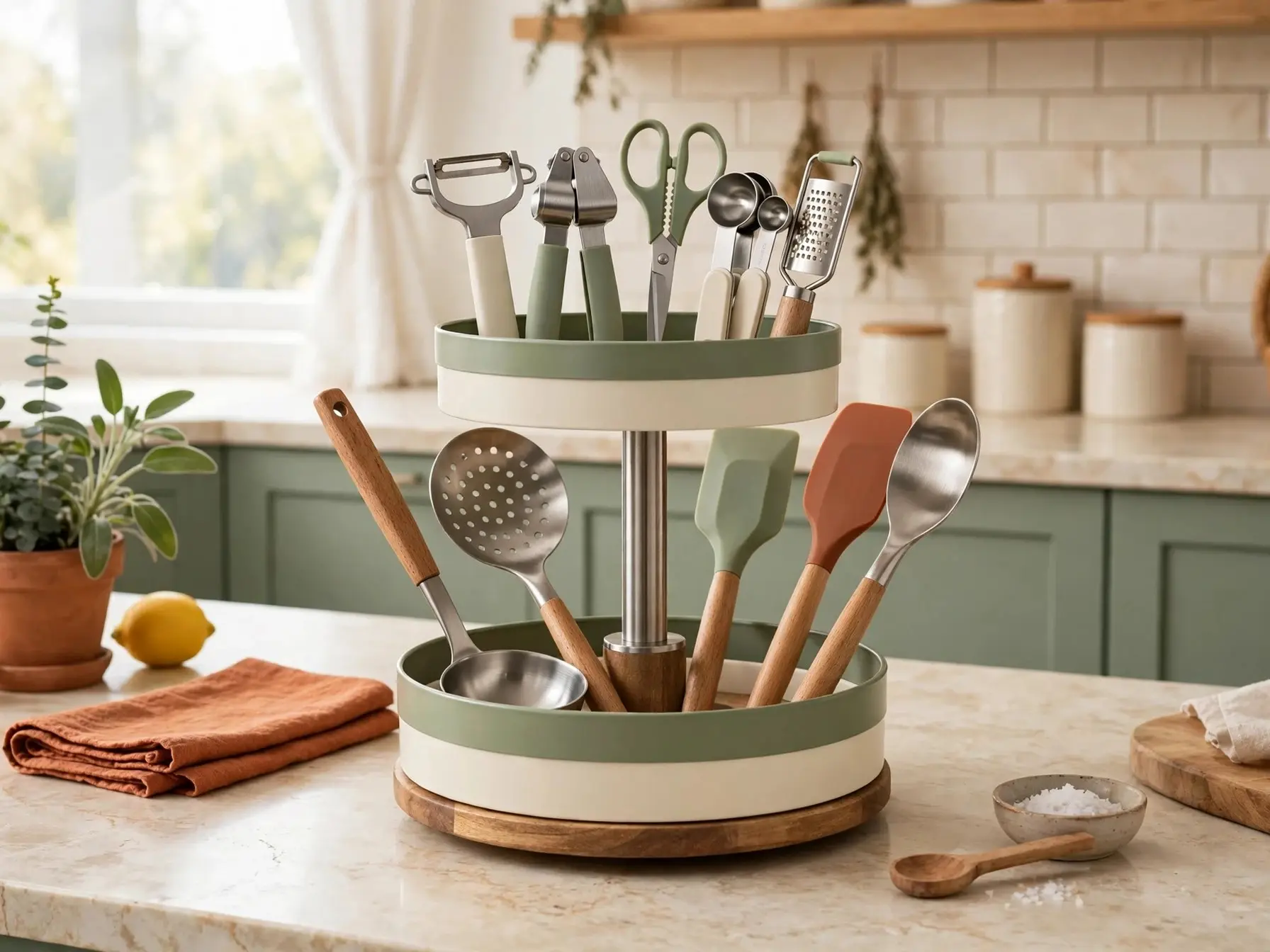
Two tiers hold nearly twice the tools in the same footprint as a single caddy, which is what a big household needs when several people cook at once. Each tier spins on its own, so nothing hides at the back, and small tools stay visible on the upper tier instead of sinking under ladles. It stands taller than a single caddy, so check the clearance under your upper cabinets first.
Keep small tools up top and heavy ladles down low, where the weight keeps the caddy steady.
Our pick
Two-Tier Rotating Caddy
Big households that cook with a lot of tools at once.
Pros: Two tiers hold nearly twice the tools in the same footprint; Each tier spins on its own, so nothing hides at the back; Keeps small tools visible instead of buried
Cons: Taller than a single caddy, so it needs clearance under cabinets; Top tier can crowd tall tools on the bottom tier
Wall, door and under-cabinet holders
These five holders use walls, doors and the space under cabinets, so the counter stays clear for cooking. Most of them need no drilling, which makes them the renter-friendly set.
10. The adhesive wall rail for renters
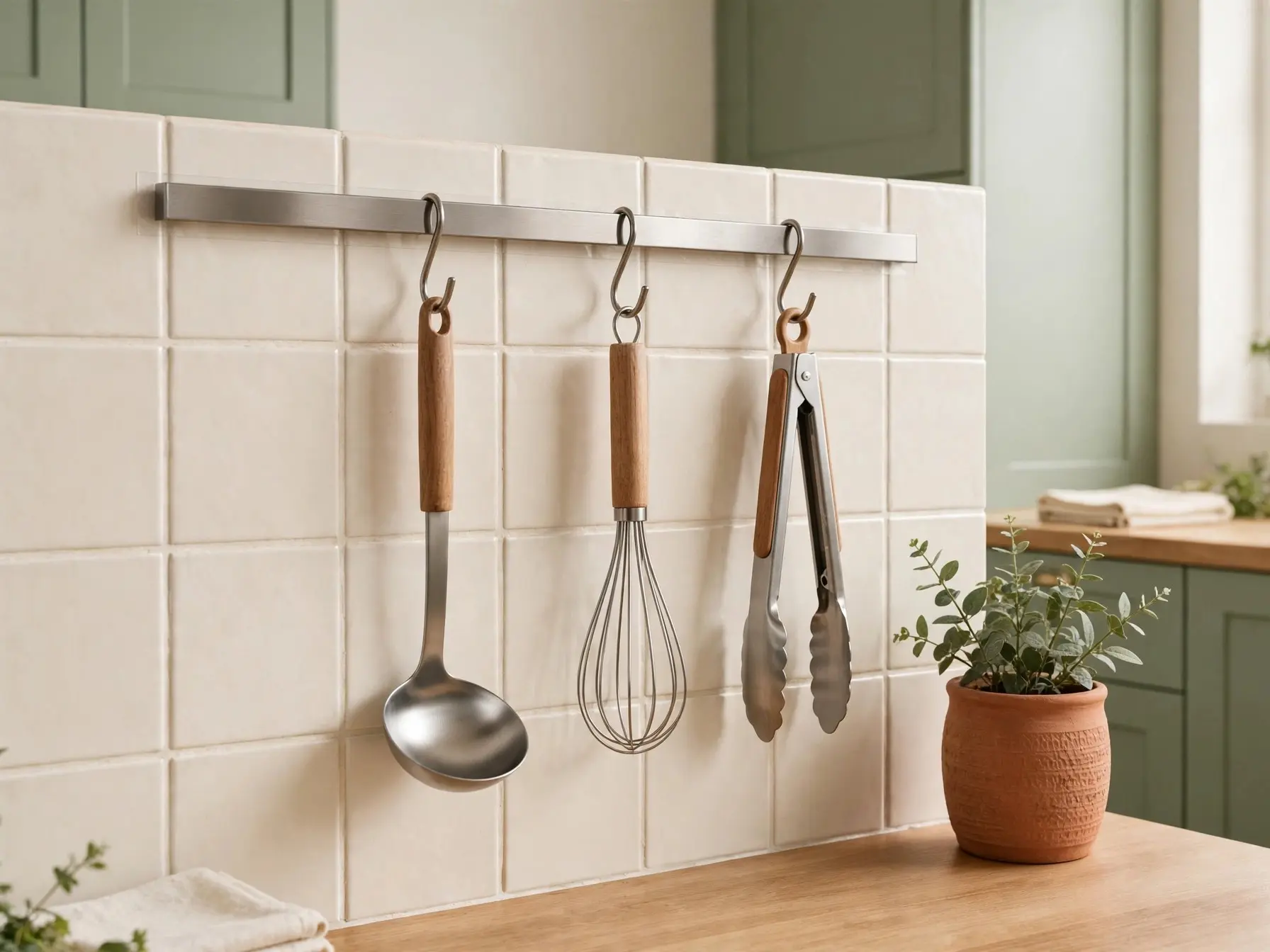
An adhesive rail gives renters the wall-rail trick with no drill and no holes: strong strips stick it to smooth tile, the S-hooks hold the daily tools, and it comes off cleanly when you move out. It costs less than most drilled rails, and it goes up in minutes. Respect its weight limit, since adhesive holds less than screws, and skip it on textured tile or in heavy steam.
Clean the tile with rubbing alcohol first and wait a full day before hanging tools on it.
Our pick
Adhesive Wall Rail, No-Drill
Renters who cannot drill into the backsplash.
Pros: Goes up with adhesive strips, no drill and no holes; Comes off cleanly when you move out; Costs less than most drilled rails
Cons: Weight limit is lower than a screwed-in rail; Adhesive can fail on textured tile or in steam
11. The hanging utensil cup on a rail
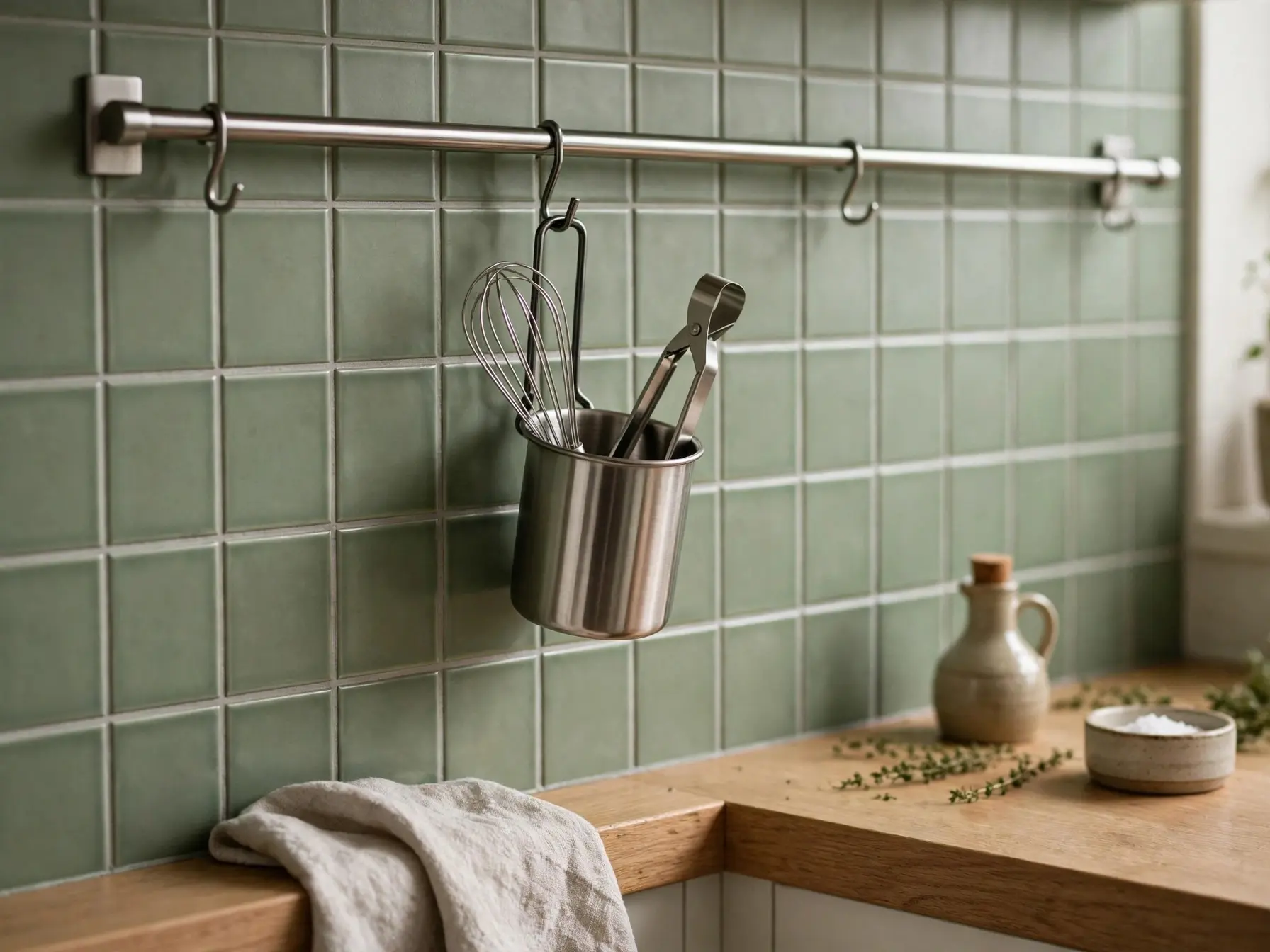
Some tools never sit well on a hook: whisks, peelers and small tongs slide off and clatter to the counter. A hanging cup clips onto any standard wall rail and corrals them in one place, and it lifts off to wash in the sink. It is the cheapest add-on in this list, and it makes a rail work for the small tools a rail alone cannot hold.
Check the cup width against your rail spacing before you buy, so it does not crowd the hooks beside it.
Our pick
Hanging Utensil Cup for Wall Rail
Small tools that slip off S-hooks, like whisks and peelers.
Pros: Catches small tools that slip off hooks; Clips onto any standard wall rail; Lifts off to wash in the sink
Cons: Adds width to the rail, so check the spacing first; Deep cups hide short tools at the bottom
12. The tension rod under the upper cabinet
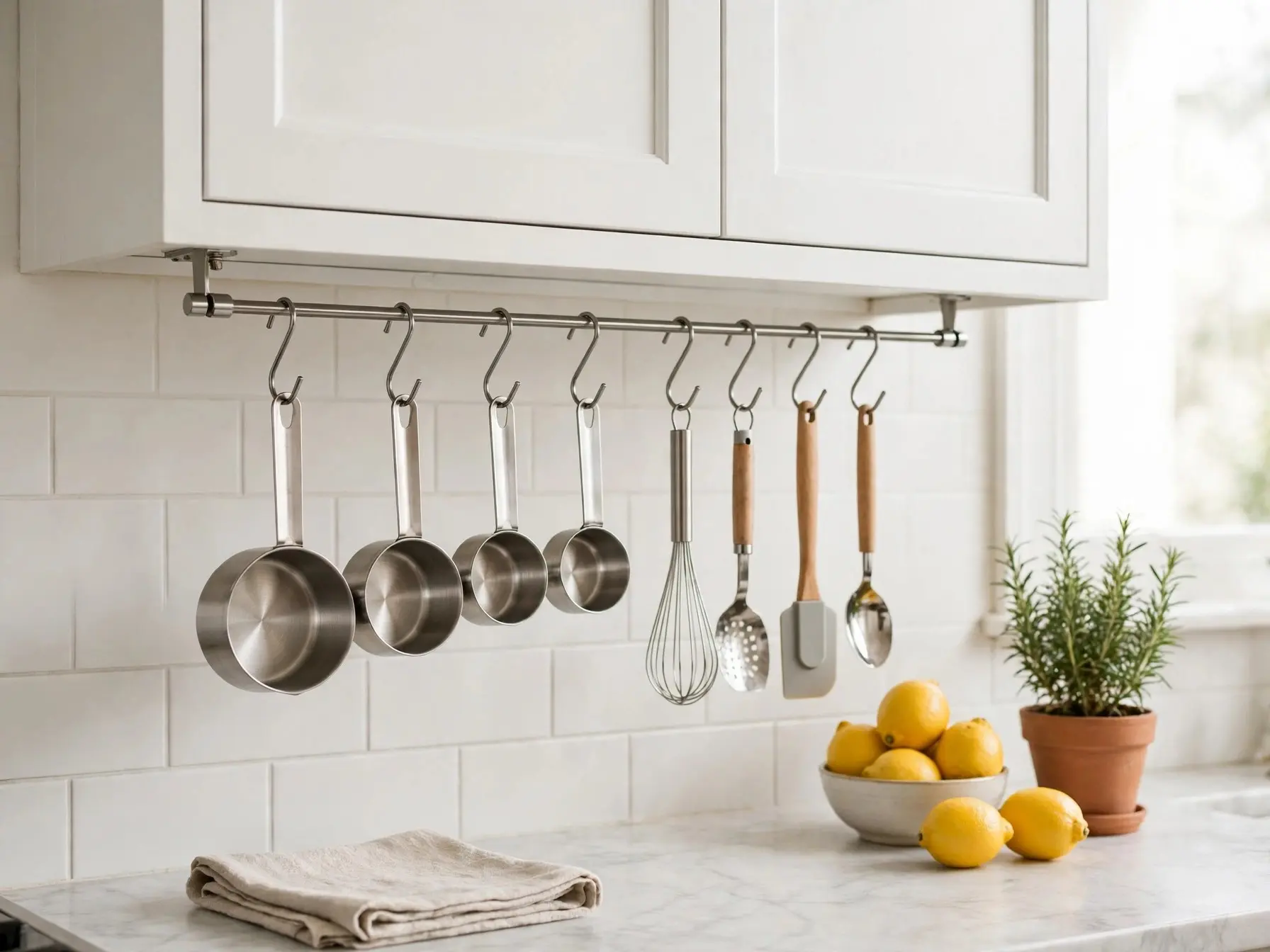
A tension rod wedges under an upper cabinet with no holes and no adhesive, and S-hooks turn it into a hanging rail for measuring cups and small utensils. It costs less than a rail, moves in a minute, and frees a whole stretch of counter in a galley kitchen. Keep it to light tools: heavy ladles can pull a rod down, and it needs a flat cabinet underside to grip.
Twist the rod a quarter-turn past snug so it holds firm when you pull a cup off a hook.
Our pick
Tension Rod for Under-Cabinet Storage
Galley kitchens with free space under the upper cabinets.
Pros: No holes, no adhesive — it wedges in place; Costs less than a rail and moves in a minute; Frees a whole stretch of counter
Cons: Holds light tools only; heavy ladles can pull it down; Needs a flat cabinet underside to grip
13. The over-the-cabinet-door holder
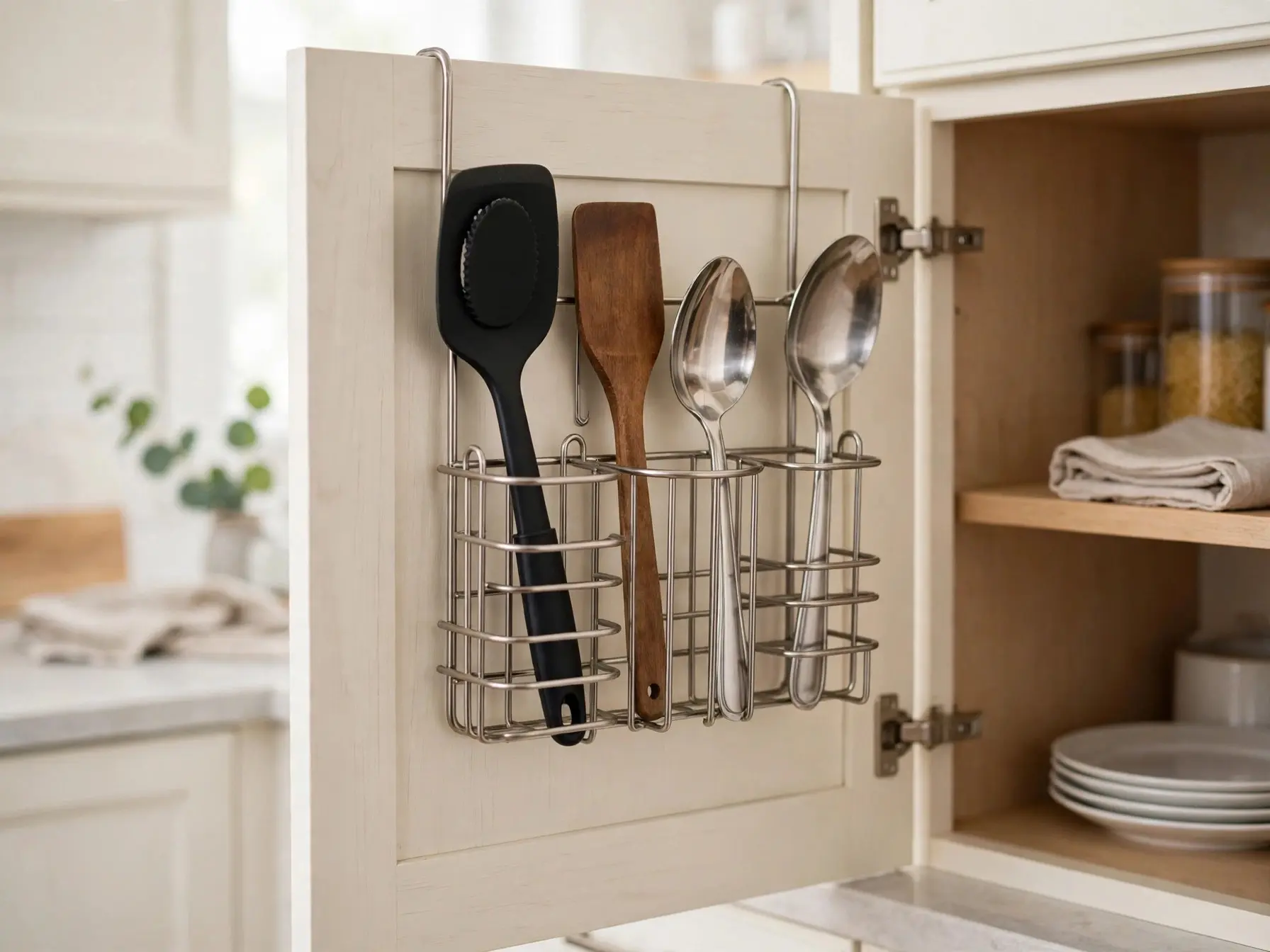
The inside of a cabinet door is dead space in most kitchens, and a holder that hooks over the top of the door puts it to work. Spatulas and serving spoons hang inside the cabinet, out of sight, right where the pans live. No drilling and no adhesive, but check the door clearance first: the door needs about an inch of spare depth to close over the hooks.
Hang it on the cabinet nearest the stove, so the tools are where you cook, not where you store.
Our pick
Over-the-Cabinet-Door Utensil Holder
Kitchens where the inside of a cabinet door is wasted space.
Pros: Hides tools inside the cabinet, out of sight; No drilling or adhesive needed; Keeps tools right where the pans live
Cons: Needs about an inch of door clearance to close; Holds fewer tools than a rail
14. The wall-mounted peg rail with hooks
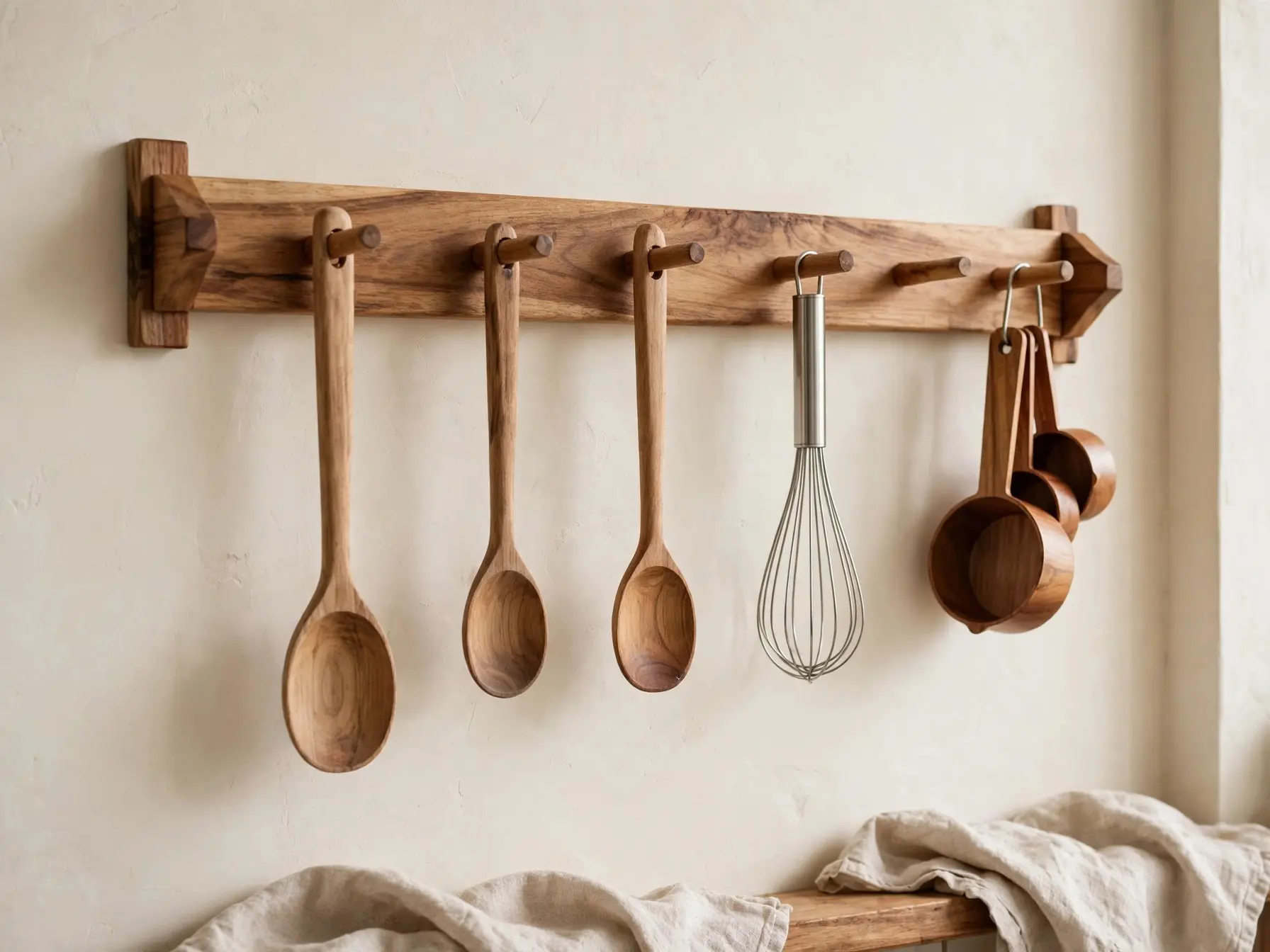
A peg rail is the warm, cottage-style cousin of the steel wall rail: wooden pegs slide along the rail, so the layout changes any time, and it holds measuring cups and tools on the same stretch of wall. It suits a farmhouse kitchen far better than steel, and it costs about the same. Screw it into a stud for a full load, since pegs pulled at an angle can work loose.
Leave one peg free at each end for the tools you reach for with wet hands.
Our pick
Wood Peg Rail With Hooks
Cottage-style kitchens and cooks who hang measuring cups too.
Pros: Pegs move along the rail, so the layout changes any time; Warm wood suits cottage and farmhouse kitchens; Holds cups and tools on the same rail
Cons: Needs screws into a stud for a full load; Pegs can work loose if they are pulled at an angle
Drawer trays and space-saving extras
The last seven picks hide tools in drawers or solve one specific problem, from a knife block that eats counter space to flatware that needs to travel to the table for a holiday dinner.
15. The deep drawer divider insert
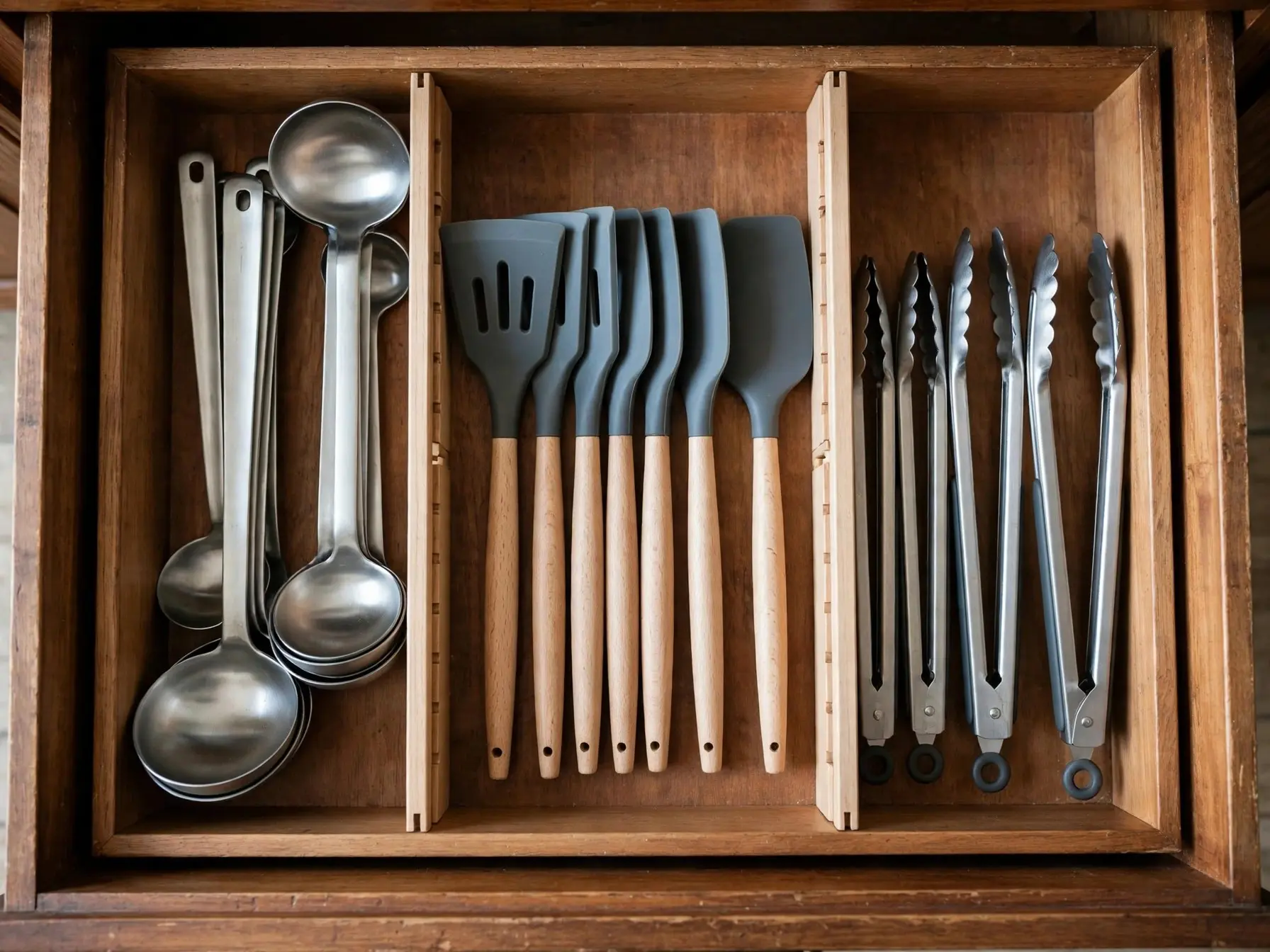
Deep drawers are where ladles and serving spoons go to vanish, and adjustable dividers fix that. The dividers slide to fit whatever you own, so bulky ladles lie flat in their own section instead of sliding under everything else. It keeps the counter clear and the drawer calm, but it needs a deep drawer: shallow drawers will not close over a ladle.
Give ladles the deepest section and keep spatulas flat on top, so nothing stacks.
Our pick
Adjustable Deep Drawer Divider Insert
Deep drawers that swallow ladles and serving spoons.
Pros: Dividers slide to fit whatever you own; Deep sections hold bulky ladles flat; Keeps the counter clear and the drawer calm
Cons: Needs a deep drawer; shallow drawers will not close; Dividers can shift if the drawer slams
16. The knife and utensil combo tray
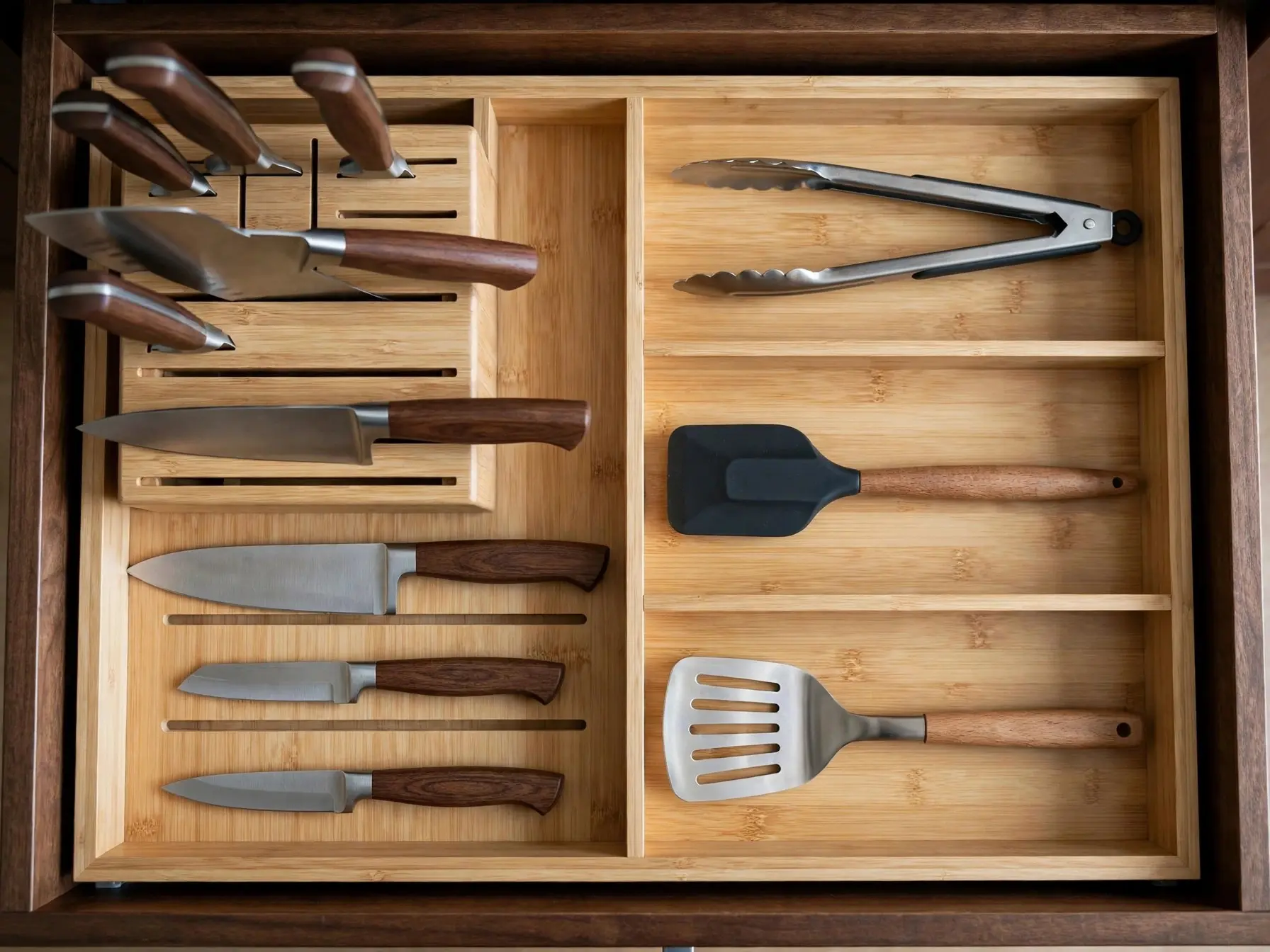
A knife block eats a surprising amount of counter, and a combo tray moves the whole block into a drawer. One tray covers knives and tools together: slots protect the blades and your fingers, while spatulas and tongs sit in their own sections beside them. It needs a wide drawer to fit knives and tools side by side, and long chef knives may not fit a short drawer.
Point every blade the same way and keep the tray away from the drawer you open with wet hands.
Our pick
In-Drawer Knife and Utensil Combo Tray
Kitchens where the knife block is eating counter space.
Pros: Frees the counter by moving the knife block into a drawer; Slots protect blades and fingers; One tray covers knives and tools together
Cons: Needs a wide drawer to fit knives and tools side by side; Long chef knives may not fit short drawers
17. The slim drawer tray for narrow drawers
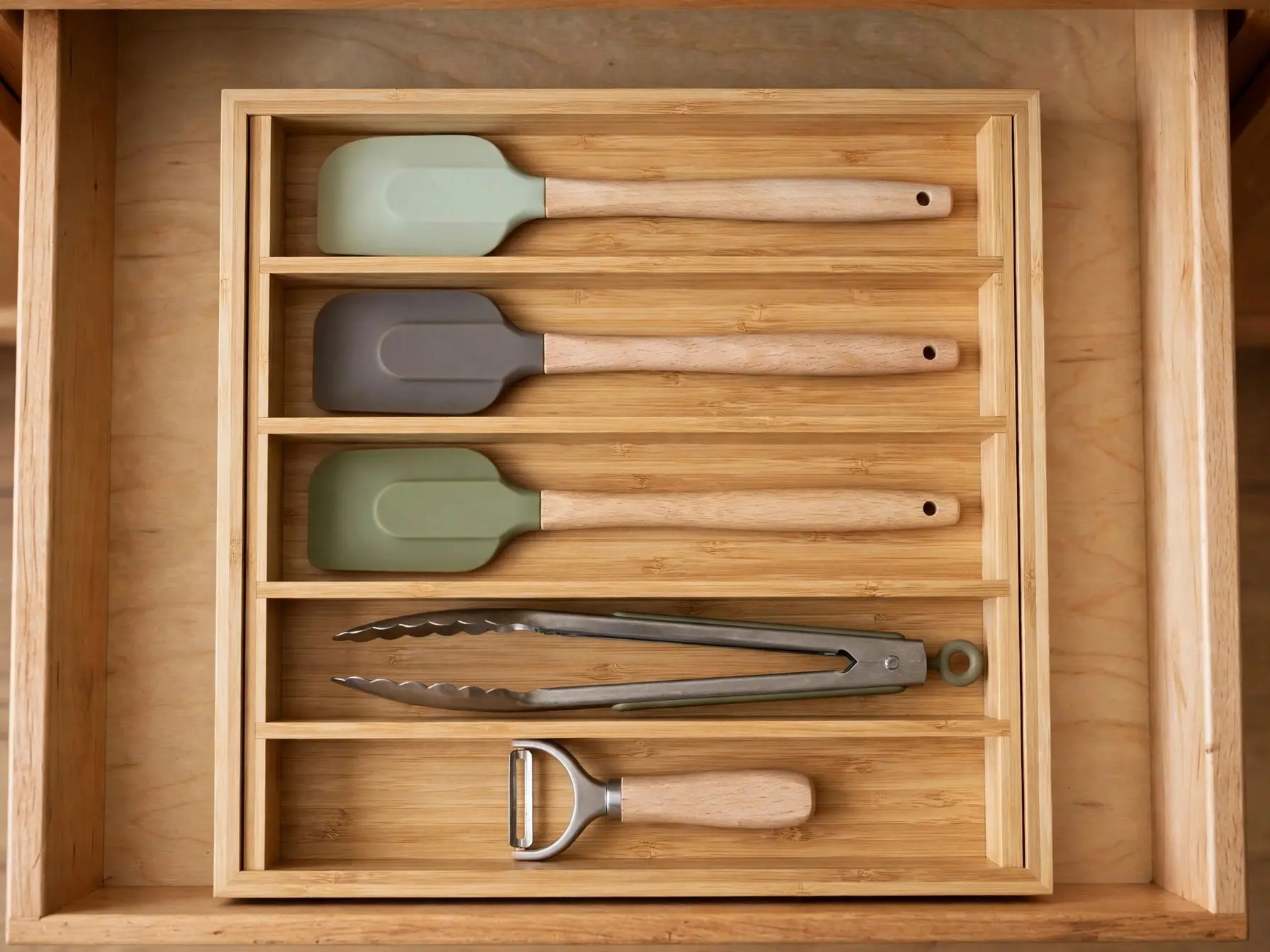
Small kitchens often have one narrow drawer and nothing else, and a slim tray uses every inch of it. At about 9 inches wide it fits drawers a standard tray cannot, and it holds the five to eight daily tools in neat rows instead of a tangled pile. It will not hold the whole collection, but the daily tools are the ones that matter.
Keep the rest of the tools on a wall rail, and the narrow drawer stays a daily-tools drawer.
Our pick
Slim Bamboo Drawer Tray for Narrow Drawers
Narrow drawers in small kitchens and apartments.
Pros: Fits drawers as narrow as 9 inches; Uses the whole drawer instead of wasting the edges; Light enough to lift out for cleaning
Cons: Holds only the daily tools, not the whole collection; No room for bulky ladles
18. The flatware caddy with handles
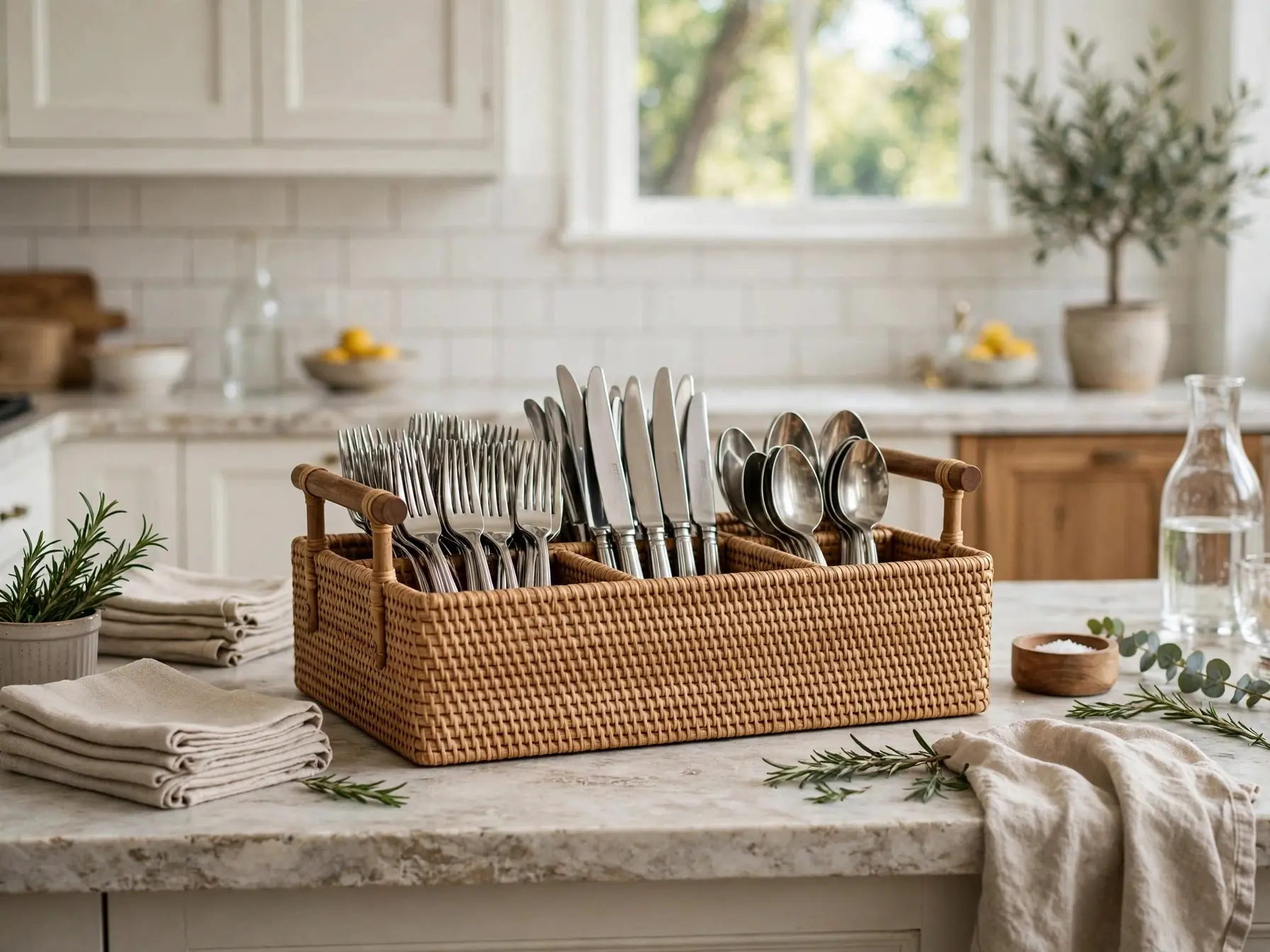
A flatware caddy with handles carries forks, knives and spoons to the table in one trip, which is exactly what a holiday dinner needs. Divided sections keep everything sorted, guests serve themselves, and the caddy comes back to the counter when the meal is over. It works every day too, not just for parties, since flatware is flatware whatever the occasion.
Set the caddy on the table before guests arrive, so the flatware is part of the table setting.
Our pick
Flatware Caddy With Handles
Holiday dinners and parties when flatware needs to travel to the table.
Pros: Carries flatware to the table in one trip; Divided sections keep forks, knives and spoons sorted; Works on the counter every day, not just for parties
Cons: Takes counter space when it is not in use; Handles can snag on cabinet doors if stored inside
19. The under-shelf hanging caddy
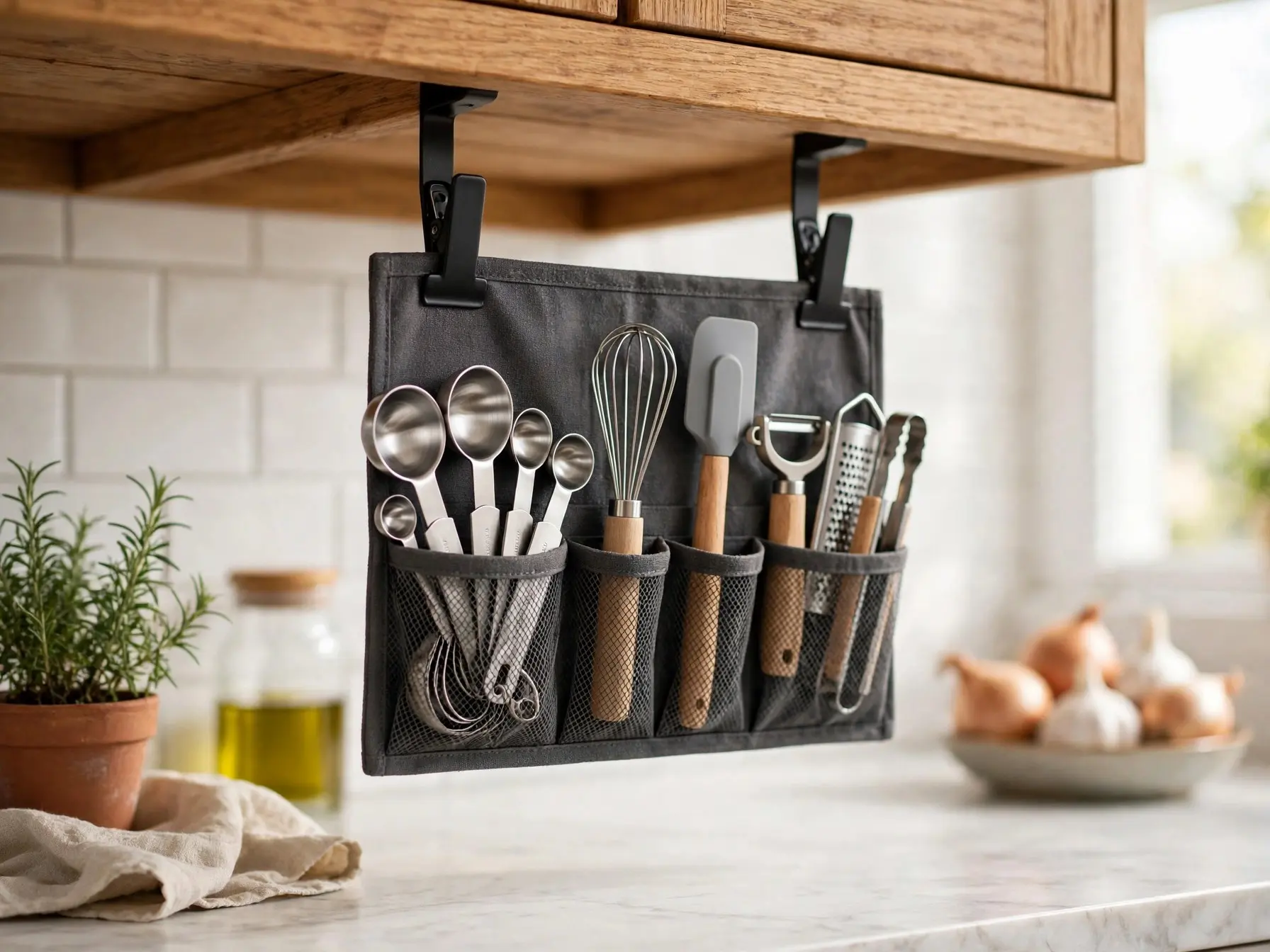
The space under a shelf is dead space in most kitchens, and a hanging caddy clips onto it with no tools and no holes. Measuring spoons, small whisks and peelers sit where you can see them, right under the shelf where the spices live. It holds light items only, and it can block the shelf below if it hangs too low, so check the clearance first.
Clip it under the shelf nearest the stove, so the measuring spoons are where the cooking happens.
Our pick
Under-Shelf Hanging Utensil Caddy
Small tools and measuring spoons in kitchens with open shelves.
Pros: Uses the dead space under a shelf; Clips on with no tools or holes; Keeps measuring spoons where you can see them
Cons: Holds light items only; Can block the shelf below if it hangs too low
20. The utensil carousel with knife slots
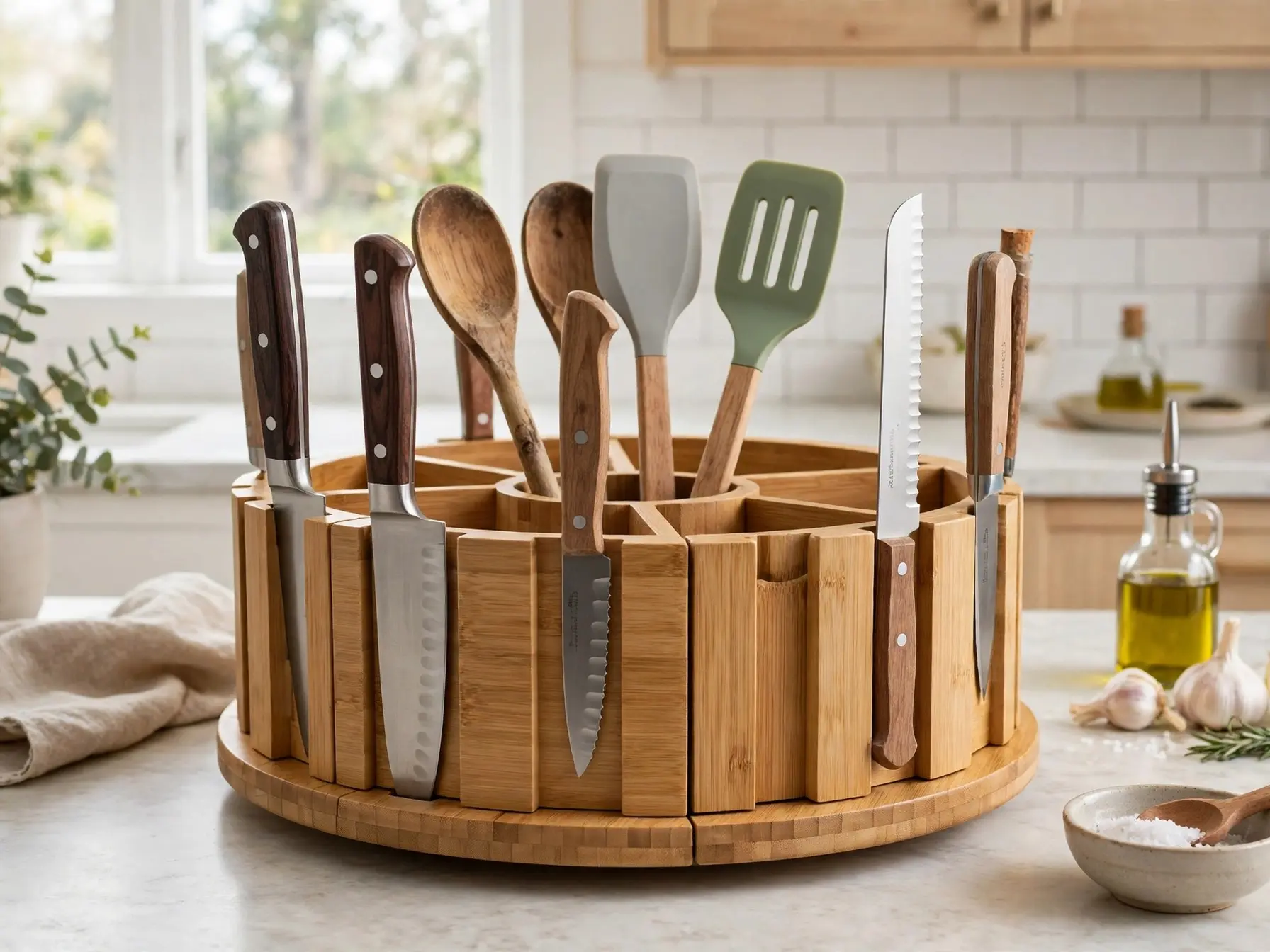
A carousel with knife slots replaces two counter items at once: the crock and the knife block. It spins, so every tool is one turn away, and the slots keep blades safe and out of the drawer. It is wider than a plain crock, so it needs more counter, but it gives back the whole footprint of the knife block it replaces.
Wipe the knife slots out now and then, since crumbs and moisture collect in them.
Our pick
Rotating Utensil Carousel With Knife Slots
Counters crowded by both a crock and a knife block.
Pros: Replaces a crock and a knife block with one spinning unit; Knife slots keep blades safe and out of the drawer; Spins, so every tool is one turn away
Cons: Wider than a plain crock, so it needs more counter; Knife slots need cleaning now and then
21. The stackable nesting crock set
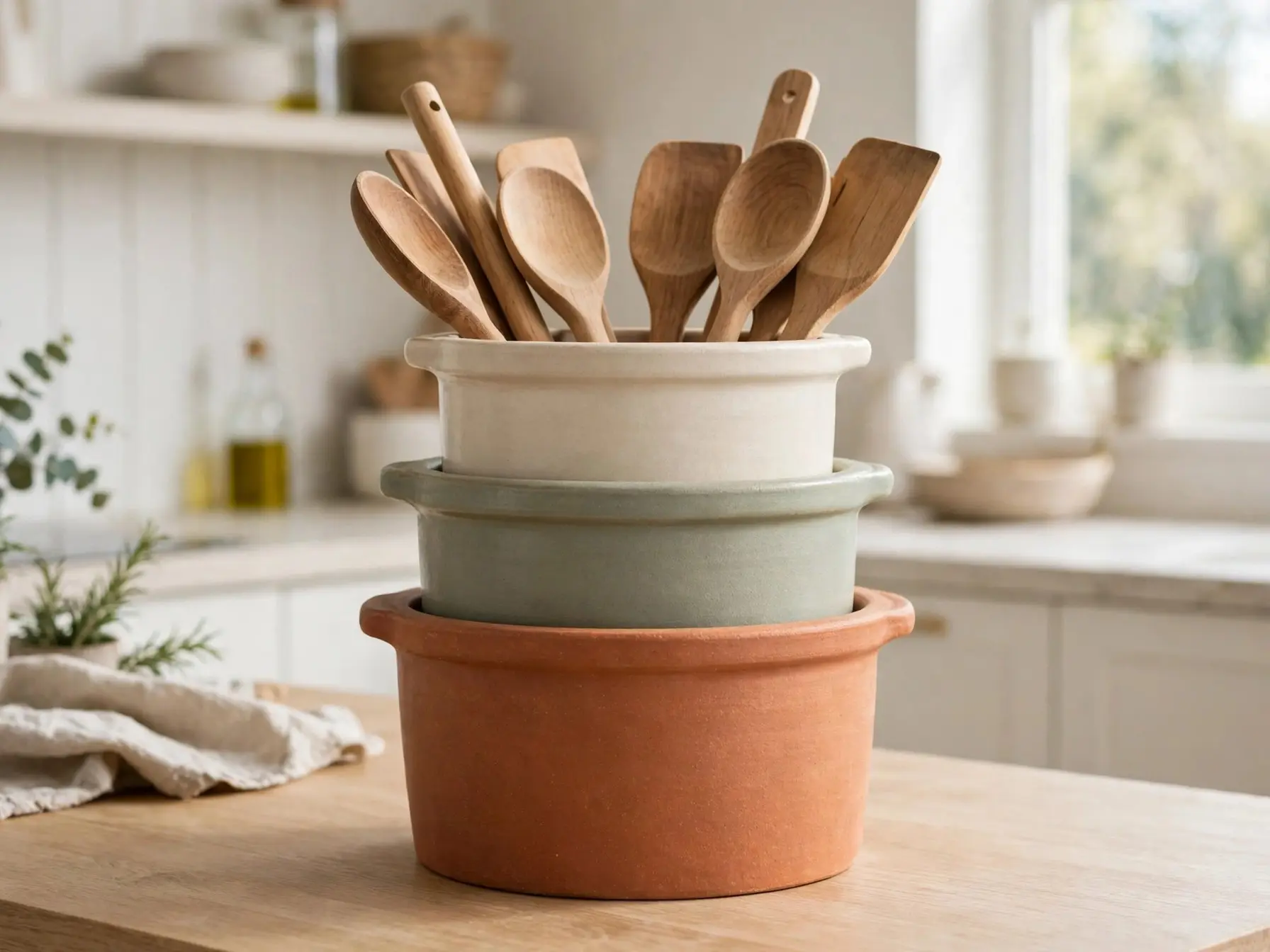
Three crocks sort tools by type or by cook: wooden spoons in one, metal tools in another, baking tools in the third. Use one for everyday cooking and bring out all three for holiday cooking, when the kitchen needs every tool at once. They nest for storage when you need only one, and the cream, sage and terracotta colors match the kitchen rather than fighting it.
Keep the smallest crock for the tools you use least, so it never tips with only one tall tool inside.
Our pick
Nesting Ceramic Utensil Crock Set of 3
Kitchens that change with the seasons — one crock for everyday, three for holiday cooking.
Pros: Three crocks sort tools by type or by cook; Nests for storage when you need only one; Colors match the cream, sage and terracotta palette
Cons: Three crocks take more counter than one; Smallest crock tips if it holds only one tall tool
Questions, answered
How do I decide where to put things in my kitchen?
Keep each tool within arm’s reach of where you use it: cooking tools by the stove, prep tools by the counter where you chop, and serving tools near the table or the cupboard where the dishes live. Put the five to eight tools you use daily in the easiest spot, and move the rest to a drawer tray or a higher shelf.
Should cooking utensils be in a drawer or on the counter?
Daily tools belong where you can grab them without opening anything, so a crock, caddy or wall rail by the stove suits them best. Tools you use once a week or less are better in a drawer tray, where they stay clean and out of the way. Most kitchens work best with both: the daily tools on show, the rest tucked away.
How many utensils should go in a utensil holder?
Keep five to eight tools in the holder by the stove, which is the set most cooks reach for daily. A standard crock holds eight to twelve, but a jammed crock hides the tool you want, so move the extras to a drawer tray or a wall rail. Count the tools you actually used last week, and that is the number your holder needs to hold.
What is the best utensil holder for a small kitchen?
A stainless wall rail with S-hooks is the best pick for a small kitchen, because it holds eight to twelve tools and uses no counter space at all. A magnetic holder on the side of the fridge is the next best option when the wall is taken. Both cost under $30 and come in renter-friendly versions that need no drilling.
Keep reading
Utensils are one piece of a kitchen that stays tidy on a system. Our guides to kitchen organization ideas, pantry organization ideas, and a cleaning schedule for the whole home all build on the same idea: give everything one home, and the small space stops fighting you.
Pick the holder that fits the kitchen you have, not the one you wish you had. Measure once, start with the rail or the tray, and keep only the tools you use every week within reach. The counter clears fast once every tool has one home.